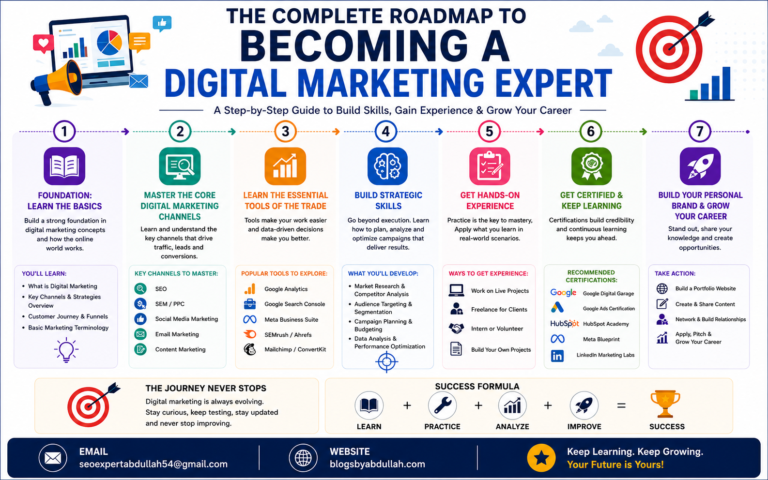
A digital marketing roadmap provides a clear and structured path for anyone who wants to build a successful career in online marketing. It begins with learning the fundamentals of digital marketing, including customer behavior, marketing strategies, and online platforms. After understanding the basics, the next step is mastering important channels such as SEO, social media marketing, email marketing, content marketing, and paid advertising. Learning industry tools like Google Analytics, Google Search Console, and SEMrush helps marketers track performance and make data-driven decisions. Developing strategic thinking, audience analysis, and campaign planning skills is also essential for long-term success. Practical experience through internships, freelancing, and personal projects helps strengthen real-world knowledge and confidence. Finally, continuous learning, earning certifications, and building a strong personal brand allow digital marketers to stay competitive and grow their careers successfully.
Lorem ipsum dolor sit amet, consectetur adipiscing elit. Morbi faucibus, arcu sed convallis sollicitudin, purus magna hendrerit nunc, sed aliquet erat arcu non nisi. Integer luctus eros nec sem sagittis, non faucibus arcu euismod. Sed varius, lectus at tristique blandit, velit lacus malesuada mauris, sit amet gravida eros augue in metus. Vestibulum vel felis nec nunc elementum iaculis vel at mauris.
A digital marketing roadmap provides a clear and structured path for anyone who wants to build a successful career in online marketing. It begins with learning the fundamentals of digital marketing, including customer behavior, marketing strategies, and online platforms. After understanding the basics, the next step is mastering important channels such as SEO, social media marketing, email marketing, content marketing, and paid advertising. Learning industry tools like Google Analytics, Google Search Console, and SEMrush helps marketers track performance and make data-driven decisions. Developing strategic thinking, audience analysis, and campaign planning skills is also essential for long-term success. Practical experience through internships, freelancing, and personal projects helps strengthen real-world knowledge and confidence. Finally, continuous learning, earning certifications, and building a strong personal brand allow digital marketers to stay competitive and grow their careers successfully.
Digital marketing means promoting products and services through online channels like search engines, social media, email, and websites. Instead of a newspaper ad or a billboard, a digital marketer creates content that reaches people on their phones and computers.
The field has grown rapidly. Global digital ad spending is expected to pass 700 billion dollars by the end of 2026. Every company that wants to stay competitive needs skilled digital marketers. That means millions of job openings are available worldwide, and demand keeps growing year after year.
What makes this career even more attractive is the flexibility. You can work for a company full-time, join a marketing agency, or freelance from anywhere in the world. You can also specialize in one area like SEO or social media, which means your income can grow quickly once you build expertise.
Digital marketing works well for people who are curious, creative, and willing to learn from data. You do not need to be a designer or a programmer. You just need to enjoy working with ideas, experimenting with strategies, and measuring results. If you are good at writing, SEO and content marketing will come naturally to you. If you enjoy numbers and spreadsheets, analytics and paid advertising will suit you well. If you love social media and staying on top of trends, social media marketing is a perfect fit. The best part is that many skills you already have carry over directly. Writing, communication, project management, customer service, and even basic computer skills all translate well into digital marketing.
Before you start learning tools, you need to understand what digital marketing actually includes. There are several main channels and you do not need to master all of them at once.
SEO is the process of making a website show up on Google and other search engines without paying for ads. You do this by writing useful content, using the right keywords, and making sure the website is technically healthy. SEO takes time to show results but brings long-term free traffic.
Social media marketing involves creating and managing content on platforms like Instagram, Facebook, LinkedIn, TikTok, and Twitter. The goal is to grow an audience, build trust, and drive people to take action. Each platform has its own style and audience.
Content marketing means creating helpful blog posts, videos, guides, and other content that attracts people to a website or brand. Good content builds trust and brings in organic traffic over time.
Email is still one of the highest-return channels in digital marketing. Email marketers build lists of subscribers and send them regular newsletters, promotions, and updates. The goal is to keep people engaged and turn them into loyal customers.
Video is growing faster than almost every other content format. YouTube is the second largest search engine in the world. Brands use video to explain products, build trust, and reach new audiences. Basic video editing and scripting skills are becoming more important every year.
Analytics is the foundation of smart marketing. Tools like Google Analytics show you how many people visit a website, where they come from, what they do, and whether they buy. Understanding data helps you make better decisions and prove that your work is delivering results.
The best way to start learning is to use free resources and earn free certifications. You do not need to spend money on expensive courses when you are just beginning. Free Certifications to Start With Google Digital Marketing and Ecommerce Certificate covers SEO, analytics, email, and paid ads in a structured way. Complete at least two of these certifications before applying for your first job. They signal to employers that you are serious and have practical knowledge.
AI tools have changed how digital marketers work. Learning to use them early gives you a real advantage. ChatGPT can help you write ad copy, brainstorm content ideas, and create email drafts in seconds. Jasper is an AI writing tool used by marketing teams to produce content faster. Surfer SEO uses AI to analyze your content and suggest keyword improvements. Canva now includes AI features that help you create graphics and social media posts much faster than before. Using these tools does not replace your skills. It makes you more productive and shows employers that you are up to date with how modern marketing works.
The best way to start learning is to use free resources and earn free certifications. You do not need to spend money on expensive courses when you are just beginning. Free Certifications to Start With Google Digital Marketing and Ecommerce Certificate covers SEO, analytics, email, and paid ads in a structured way. Complete at least two of these certifications before applying for your first job. They signal to employers that you are serious and have practical knowledge.
You do not need to wait for a job offer to start building real experience. The best digital marketers start practicing before they ever apply for a position. Start Your Own Blog or Social Media Page Create a blog or a social media account on a topic you are genuinely interested in. Apply SEO techniques, write content consistently, and track your growth using Google Analytics. This gives you a real project you can show employers and it proves that you can actually do what you say you can do. Volunteer for a Small Business or Nonprofit Reach out to a local business or charity and offer to manage their social media or improve their website for free or a small fee. Real-world client work, even unpaid, is extremely valuable for your portfolio and confidence. Run Small Paid Ad Campaigns on a Low Budget You can run a Facebook or Google ad for as little as five to ten dollars. Try running a small campaign for your blog or for a local business. Measure the results. Learn what works and what does not. This hands-on experience is worth more than any textbook.
A portfolio is the most important thing you can create as a beginner digital marketer. Employers want to see proof of your work, not just a list of courses on your resume. What to Include in a Digital Marketing Portfolio Include screenshots of campaigns you have run and the results they produced. Add blog posts or content pieces you have written. Show before and after analytics results. Include any social media accounts you have grown. Write a short explanation for each project that describes the goal, your strategy, and the outcome. Your portfolio does not need to be perfect. It just needs to show that you have actually done something. Even personal projects and volunteer work count. Where to Host and Share Your Portfolio A simple personal website using WordPress or Wix works well. You can also build a strong LinkedIn profile that acts as an online portfolio. Link to your work from your resume so employers can see it immediately.
Once you understand the basics, choose one area to go deeper in. Specialists earn more than generalists and are easier to hire because employers know exactly what they are getting.
Pick the one that aligns with your natural strengths and interests. Build your portfolio and certifications around that specialization.
Working in-house means joining one company’s marketing team. You go deep on one brand and have more stability. Working at a marketing agency means managing multiple clients at once. You learn faster and get variety but the pace is high. Freelancing means working for yourself with multiple clients. You have full flexibility but need to handle your own client finding and income management.
All three paths are valid. Many people start in-house or at an agency to build skills and then move to freelancing once they have confidence and a network.
How to Write a Digital Marketing Resume with No Experience Focus on what you have done, not what you have not done. List your certifications at the top. Include your personal projects with specific numbers, for example how many followers you grew an account to, how much traffic your blog got, or what your email open rate was. Keep the resume to one page and make sure it is easy to scan quickly. How to Get Your First Freelance Client Tell everyone you know that you are offering digital marketing services. Post about it on LinkedIn and Instagram. Join Facebook groups for small business owners and answer questions. Offer a free audit of someone’s website or social media as a way to start a conversation. Your first client will often come from a personal connection, not a job board. Common Beginner Mistakes to Avoid Trying to learn everything at once is the most common mistake. Pick one channel, get good at it, and then expand. Only studying without practicing is another big mistake. Knowledge without action does not build a career. Many beginners also forget to track their results. Always measure what you do so you can show employers and clients proof of your impact.
Learning the Basics In the first three months, focus on learning the fundamentals. Complete two or three free certifications from Google, HubSpot, or Meta. Set up a blog or social media account and start creating content. Learn how to use Google Analytics to track basic metrics. Spend time every day reading industry blogs and following marketing professionals on LinkedIn.
Building Skills and Practice In months three to six, shift your focus from learning to doing. Run your first small ad campaign. Start a personal project or volunteer for a local business. Build your portfolio with two to three real examples of your work. Begin networking on LinkedIn and in online marketing communities.
Getting Hired or Freelancing After six months of consistent practice, you are ready to apply for entry-level jobs or pitch your first freelance clients. Update your resume with your certifications and portfolio. Apply for junior roles like social media coordinator, SEO assistant, or content writer. Send five to ten pitches per week to small businesses if you want to freelance. Stay consistent and keep improving your skills every month.
Yes. Google, HubSpot, and Meta all offer free certifications that are respected by employers. You can build strong foundational skills without spending any money at the start.
Most people who practice consistently and build a real portfolio are ready for entry-level work within 6 to 12 months.
No. Employers care far more about your skills, portfolio, and certifications than a formal degree. Many working digital marketers never studied marketing in school.
SEO is a great starting point because it teaches you how people search for information online and how to create content that gets found. Google Analytics is also highly useful early on.
Absolutely. Many digital marketers start freelancing part-time while working a regular job. Managing social media, writing blog content, or running ads for small businesses are all services you can offer from home on a flexible schedule.
Google Analytics, Google Search Console, Canva, Mailchimp, Meta Ads Manager, SEMrush, and scheduling tools like Buffer or Hootsuite are used most commonly in daily marketing work.
Digital marketing is not a career that requires a perfect background or an expensive degree. It requires curiosity, consistency, and the willingness to keep learning. Every expert you see today started exactly where you are right now, with zero experience and a lot of questions.
The roadmap is simple. Learn the basics, practice on real projects, build a portfolio, choose your specialization, and then apply for jobs or start freelancing. You do not need to do everything at once. You just need to take the first step and keep moving forward. The demand for digital marketers is only going to grow in the coming years. Businesses are spending more money online every year and they need skilled people to manage that spending. That means more job opportunities, higher salaries, and more freedom to work on your own terms. Start with one free certification today. Set up a simple blog or social media page this week. Build one real project this month. Small steps done consistently will take you further than any shortcut ever could. Your journey from zero to digital marketing professional starts with a single decision. Make that decision today and commit to it. The opportunities are already waiting for you.