

Grow your brand with smart digital strategies designed for 2025. Learn how SEO, content marketing, and online branding can help you attract more traffic, generate quality leads, and achieve long-term business success.
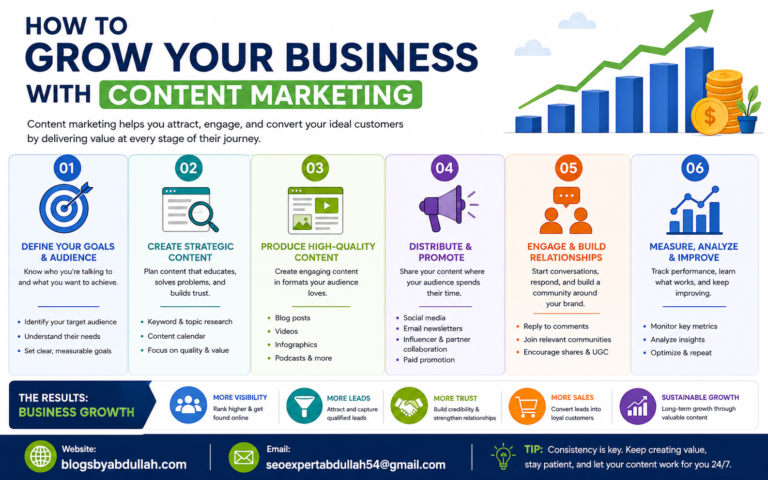
If you run a small business and you have not yet started with content marketing, you are leaving money on the table every single day. Content marketing is one of the most powerful and affordable ways to grow your business online. It does not require a big budget. It does not require a marketing team. What it does require is a clear plan, some consistency, and the willingness to share what you know.Success in 2025 is all about using smart digital strategies that bring measurable growth. Businesses need strong SEO, quality content, social media presence, and modern marketing tools to stay ahead. A well-optimized website helps attract real visitors, generate leads, and increase conversions naturally.
Content marketing is the practice of creating and sharing useful, relevant information to attract people to your business. Instead of pushing an advertisement in someone’s face, you give them something they actually want to read, watch, or listen to. When they get value from your content, they begin to trust you. When they trust you, they become your customers.it helps businesses build trust by providing useful information through blog posts, videos, social media content, emails, and more. The main goal of content marketing is to increase brand awareness, generate leads, improve website traffic, and build long-term customer relationships. High-quality content also helps websites rank better on search engines like Google, making it an important part of modern SEO strategies.
For small businesses, this matters more than ever. Big brands spend millions on television ads and billboards. You cannot compete with that. But you can write a helpful blog post that shows up when someone searches Google. You can make a short video that answers a question your customers ask every week. That is the power of content marketing, it levels the playing field between a small local business and a large corporation.
Traditional advertising interrupts people. A television commercial plays when someone is trying to watch their favourite show. A pop-up ad appears when someone is reading an article. People have learned to ignore these things. Content marketing works differently. It earns attention instead of forcing it. When someone searches for how to fix a leaking pipe and finds your plumbing blog post, they came to you. You did not interrupt them. You helped them. That is a completely different relationship, and it is one that builds loyalty over time. The other major difference is cost. A single television ad can cost tens of thousands of dollars and is forgotten in seconds. A well-written blog post can bring in traffic for years with no ongoing cost after it is published.
Large companies struggle to feel personal and authentic. Their content often goes through layers of approvals before it reaches the public. It ends up feeling polished but lifeless. As a small business owner, you have something they do not have. You have a real story, real opinions, and real expertise. Your customers can connect with you as a person, not just a brand. This authenticity is your biggest competitive advantage. Lean into it.
The biggest mistake small business owners make with content marketing is jumping straight into creating content without knowing why they are doing it. Before you write a single word, you need to answer one question: what do you want your content to do for your business?
Bring more visitors to your website through search engines. Build an email list of people who are interested in what you offer. Educate potential customers so they are ready to buy. Show your expertise so people trust you over your competitors. Keep existing customers engaged so they come back and refer others. You do not need to achieve all of these at once. Pick one or two goals and focus on them. A clear goal gives your content direction and makes it much easier to know if what you are doing is working.
Vague goals lead to vague results. Instead of saying you want more website visitors, say you want to grow your monthly organic traffic from 200 to 500 visitors within six months. A specific goal like this tells you exactly what success looks like and gives you a timeline to work toward.
Content marketing only works when it speaks directly to the person you are trying to reach. If you try to speak to everyone, you will connect with no one. The more specific you are about your audience, the more powerful your content becomes.
Think about your best current customer. How old are they? What do they do for work? What problems are they trying to solve? What do they search for online? What keeps them up at night? When you have a clear picture of this person, every piece of content you create should speak to them and only them.
Your customers are already telling you what content to make. Every question they ask in an email, in a phone call, or in a chat window is a content idea. Every complaint they have is a content idea. Every thing they misunderstand about your product or service is a content idea. Start keeping a simple list of these questions. Over time, you will have more content ideas than you could ever use.
Go to Google and start typing a question related to your business. Notice the suggestions that appear, those are real things people are searching for. Scroll to the bottom of any Google results page and look at the related searches section. Use a free tool like Answer The Public, which shows you hundreds of questions people ask about any topic. These methods cost nothing and give you real data about what your audience wants to know.
You do not need to be on every platform or create every type of content. That path leads to burnout. Instead, choose the formats that match both your audience and your own strengths.
Written content is the foundation of content marketing for most small businesses. A well-optimised blog post can appear in Google search results and bring in new visitors every single day without any ongoing effort from you. Focus on writing posts that answer specific questions your customers have.
Short videos on platforms like Instagram Reels and YouTube Shorts are currently one of the fastest ways to reach new audiences. You do not need professional equipment. A smartphone, good lighting, and something useful to say is enough. Even a thirty-second tip related to your business can get thousands of views.
Your email list is the most valuable content asset you can build. Unlike social media followers who can disappear overnight if an algorithm changes, your email subscribers belong to you. A simple weekly or monthly email keeps your business in front of people who already care about what you do.
Social media is not the best place to build an audience you own, but it is a great place to distribute your content and stay visible. Repurpose content from your blog or email into short posts. Do not try to create original content for every social platform. Use social media to send people back to your website or to join your email list.
If you prefer speaking to writing, a podcast can be a natural fit. Audio content builds deep loyalty because listeners spend time with you in a very personal way. Podcasts are especially effective for service businesses where expertise and trust are the primary selling points.
If you want long-term SEO traffic, start with blog posts. If you want fast visibility and discovery, start with short-form video. If you want to build a loyal audience you own, start with email. Pick one, get good at it, and only add more formats when the first is working consistently.
A content strategy does not need to be a complicated document. For a small business, it can fit on a single page. The key is to have a plan written down rather than making decisions randomly each week.
Content pillars are the three to five main topics your business will consistently cover. A personal finance coach might focus on budgeting, saving, investing, debt, and mindset. A local bakery might focus on recipes, behind-the-scenes content, seasonal offerings, and baking tips. Every piece of content you create should fit under one of your pillars. This creates consistency and helps search engines understand what your website is about.
Before writing about any topic, spend ten minutes searching for it on Google. Look at the top results. What are they covering? What are they missing? What questions are they not answering? Your goal is not to copy what they have done but to create something more useful, more complete, or more specific to your audience. Look for the gaps, those are your opportunities.
Your brand voice is how your content sounds when someone reads it. Are you professional and formal, or relaxed and conversational? Are you encouraging and warm, or direct and no-nonsense? Pick a voice that feels natural to you and matches what your customers expect. Write it down in one or two sentences and use it as a guide every time you create content.
Creating content is only half the work. If no one finds it, it cannot help your business. This step is about making sure your content is built to be discovered.
SEO stands for search engine optimisation. It is the practice of creating content in a way that helps Google understand what it is about so it can show it to people searching for that topic. You do not need to be a technical expert to do basic SEO. A few simple habits make a big difference.
A keyword is the phrase someone types into Google to find information. Before writing any piece of content, identify the main keyword you want it to rank for. Use that keyword naturally in your title, in your first paragraph, in at least one heading within the article, and a few times throughout the body. Do not stuff it in unnaturally. Write for the human reader first, and let the keyword fit in where it makes sense.
Your page title is the single most important factor in whether your content ranks for a keyword. Make it clear, specific, and include your main keyword. Your meta description is the short summary that appears below the title in Google results. Write it as a brief, honest summary of what the reader will get from clicking. A compelling meta description increases the number of people who click through to your page.
Internal links are links from one page on your website to another page on your website. When you write a new blog post, link to other relevant posts you have already published. This helps Google understand how your content is connected and keeps readers on your site longer, both of which improve your search rankings over time.
Not everyone who finds your content is ready to buy. Some people are just starting to learn about a problem they have. Others are comparing options. Others are almost ready to purchase and just need a final push. Your content should serve all three groups.
This is educational content for people who are just discovering a problem or topic. Blog posts that answer general questions, explainer videos, and how-to guides all fall into this category. The goal is to help, not to sell. Build trust first.
This is content for people who know what they need and are comparing options. Comparison articles, case studies, and detailed guides work well here. Show why your approach or product is a good fit without being pushy about it.
This is content that helps someone make a final decision. Customer testimonials, success stories, frequently asked questions, and clear information about your pricing or process all belong here. Make it easy for the reader to take the next step.

If your business serves customers in a specific city or region, local SEO content is one of your most powerful tools. Write blog posts and landing pages that mention your location naturally, for example a pest control company in Houston might write a guide about the most common pests in Houston homes. Create content that answers questions your local customers specifically have. Make sure your Google Business Profile is complete and regularly updated, as this directly influences how you appear in local search results.
Consistency matters more than frequency. Publishing two pieces of high-quality content each month, every month, will outperform publishing ten pieces in one week and nothing for the next two months. A content calendar keeps you consistent by removing the weekly decision of what to create next.
Open a free Google Sheet and create columns for the date, the topic, the target keyword, the content format, the distribution channels, and the status. Fill in your topics for the next four to six weeks. Aim for one to two pieces per week at most when you are starting out. Review and update the calendar every two weeks.
If you are short on time, here is the absolute minimum that can still produce results. One optimised blog post per month, one email newsletter per month using content from that blog post, and three to four social posts per week that are short takeaways from your existing content. This takes roughly three to four hours per month and it is enough to start building momentum.
Instead of creating content a little bit each day, set aside a few hours on one day and create everything for the next two to four weeks at once. Write all your blog posts in one session, record all your videos in one session, and write all your social posts in one session. Batching eliminates the daily friction of switching into creative mode and makes it far easier to stay consistent.
Creating content is only valuable if people see it. Distribution is the part most small businesses neglect, and it is just as important as creation.
Your website is your owned platform. Everything you publish here is under your control. No algorithm can bury it. This is where your long-form content should live. Every piece of content you create for other platforms should include a way for readers to find their way back here.
Email is the highest-converting distribution channel for most small businesses. Every time you publish new content, send a short email to your list letting them know it exists. Even a simple three-sentence email with a link to your latest post can drive significant traffic and engagement. Start building your email list from day one, even if it is just twenty or thirty people you know.
Do not create new content for every social post. Instead, take one piece of content and turn it into multiple posts. A single blog post can become five tweets, three Instagram captions, two LinkedIn posts, and one short video. This approach saves enormous time and keeps all your channels active without requiring constant creative energy.
The most reliable way to grow an email list is to offer something valuable in exchange for an email address. This is called a lead magnet. It could be a free guide, a checklist, a template, a discount, or access to a short video series. Put a sign-up form on your website, mention your lead magnet at the end of your blog posts, and promote it occasionally on social media. Your email list is an asset that no platform can take away from you.
One of the biggest mistakes small business owners make is treating every piece of content as a one-time event. You work hard to create it, you publish it, and then you move on. Instead, think of each piece of content as a seed that can grow in many directions.
Start with your longest, most detailed piece of content, usually a blog post or a video. That becomes your core content. From there, extract key ideas and turn them into shorter pieces for other platforms. A detailed blog post can become an email newsletter, a series of social media posts, a short video summary, an infographic, a podcast episode, and a set of quote graphics. The same core ideas reach different audiences in different formats, and the work you already did is multiplied several times over.
Canva lets you turn written content into visual graphics quickly with no design experience needed. Descript allows you to transcribe and edit video and audio content. Buffer and Later help you schedule social media posts in advance. These tools are either free or very affordable and they make the repurposing process significantly faster.
Artificial intelligence tools have changed what is possible for small business content creation. Tasks that used to take hours can now take minutes. This does not mean letting a machine write all your content for you. It means using AI to handle the repetitive or time-consuming parts so you can focus on the parts only you can do.
Generating blog post outlines and content ideas based on your topic. Writing first drafts that you then edit and personalise in your own voice. Repurposing existing content into different formats. Creating social media captions from a longer article. Writing email subject lines and meta descriptions. Summarising long research articles so you can get to the useful information quickly.
Claude and ChatGPT are excellent for drafting written content, brainstorming ideas, and repurposing existing material. Canva now includes AI tools for generating images and design elements directly within the platform. Descript uses AI to edit video and audio by editing the text transcript instead of the raw footage. CapCut automatically adds subtitles and edits short-form video. Most of these tools have free plans that are more than enough for a small business starting out.
Always edit AI-generated content before publishing. Add your own examples, your personal opinions, and specific details about your business or customers. The AI provides the structure and the first draft. You provide the authenticity and the expertise. Never publish AI content without reading it carefully and making it sound like you.
Content marketing is not a one-time project. It is an ongoing process of creating, measuring, and improving. The businesses that get the best results from content marketing are the ones who look at their data regularly and use it to make better decisions.
Organic traffic is the number of visitors who find your website through search engines. This is the clearest sign that your SEO content is working. Engagement rate on social media tells you what content resonates with your audience versus what gets ignored. Email open rate tells you if your subject lines are compelling and if your subscribers still care about what you are sending. Lead generation tells you how many people are taking the next step, signing up for your email list, booking a call, or filling out a contact form. Search rankings tell you which keywords your content is appearing for and whether those positions are improving over time.
Google Analytics 4 is completely free and shows you exactly how many people visit your website, where they come from, and what they do when they arrive. Google Search Console is also free and shows you which keywords your pages are appearing for in Google, how many impressions and clicks you are getting, and which pages are performing best. Most social media platforms have built-in analytics that show your reach, engagement, and follower growth. Check these numbers once a month at minimum.
A content audit is a review of all the content you have published to see what is working and what is not. Look at your top-performing pages and ask why they are succeeding. Look at your lowest-performing pages and ask if they need to be improved, updated, or combined with another post. Delete or redirect content that is outdated and adding no value. Refresh content that is still relevant but getting less traffic than it should. A quarterly content audit keeps your content library healthy and improving over time.
Content marketing takes time. Most businesses do not see significant organic traffic results for three to six months after they start publishing consistently. Do not give up after four weeks because nothing seems to be happening. That said, if after six months of consistent effort a particular type of content is getting no engagement and no traffic, it is time to try a different approach. Patience and persistence matter, but so does being willing to adapt.
A plumber who writes a blog post titled the five most common reasons your toilet keeps running, optimised for local search terms, will appear when homeowners in their city search for that problem. The homeowner reads the post, learns that they trust this plumber, and calls them when the DIY fix does not work. This is content marketing working exactly as it should.
An accountant who publishes a monthly newsletter with practical tax tips for small business owners builds a reputation as the most helpful accountant in their area. When any of those subscribers or their friends need an accountant, there is only one name they think of. The content did the selling without a single sales pitch.
An online clothing store that creates buying guides, style tips, and seasonal lookbooks gives shoppers a reason to keep coming back to the website even when they are not ready to buy. When they are ready to buy, they already feel a connection to the brand and are far more likely to choose it over a competitor they found through an ad.
In every case, the business is creating content that genuinely helps their specific audience. They are not creating content about themselves. They are creating content about the problems, questions, and interests of the people they want to serve. That is the foundation of all effective content marketing.
Publishing random content with no clear audience, no defined goals, and no keyword research is unlikely to produce results. Before you invest time in content creation, spend a few hours building a simple strategy. Even one page of clear direction will make everything you create significantly more effective.
Most business owners naturally want to talk about their products, their services, and their achievements. But customers do not care about you until they believe you care about them. Make your content about your audience’s problems, questions, and goals. Mention your product or service only when it is directly relevant to solving a problem the content is addressing.
Content marketing is a long-term investment. Most businesses that give up do so around the three to four month mark, right before results start to compound. The businesses that succeed are the ones that commit to at least twelve months of consistent effort before evaluating whether it is working. Treat your content like a savings account: the contributions feel small at first, but the compound growth over time is remarkable.
Many small business owners spend ninety percent of their content time creating and ten percent distributing. It should be closer to fifty-fifty. A great piece of content that no one sees creates no value for your business. Every time you publish something, have a plan for getting it in front of people, through email, social media, and any other relevant channels you have access to.
New social media platforms appear constantly and there is always pressure to be everywhere at once. Trying to maintain a strong presence across six different platforms simultaneously will exhaust you and produce mediocre results across all of them. Pick two platforms where your audience is most active and do those well. Expand only when you have consistent, repeatable systems on the first two.
This is one of the most common questions small business owners ask when they are deciding where to invest their marketing time and budget. The honest answer is that both have a place, but they work very differently and at different time horizons.
Paid advertising produces results immediately but stops the moment you stop paying. If you spend five hundred dollars on Facebook ads this month and do not spend anything next month, the traffic stops. Content marketing produces results slowly at first but continues to work long after you have done the initial work. A blog post you write today can bring in visitors and leads for the next three to five years with no additional cost.
If you are just starting out and have more time than money, focus on content marketing. The returns are slower but the investment pays off compoundingly over time. Build your blog, grow your email list, and establish your organic presence before spending money on ads.
Once your content is producing consistent organic results, adding a small paid budget to amplify your best-performing content is an extremely efficient approach. You are paying to accelerate something that is already working rather than paying for something that stops the moment your budget runs out.
If you are doing it yourself using free tools like Google Docs, Canva, and Google Analytics, the cost is only your time. A practical starting budget for a small business that wants some paid tools is around one hundred to three hundred dollars per month, which can cover a scheduling tool, an AI writing assistant, and stock imagery. Hiring a freelance content writer or a small agency typically costs between one thousand and three thousand dollars per month.
Most small businesses begin to see measurable results in the form of increased organic traffic within three to six months of publishing consistently. More significant results such as appearing on the first page of Google for competitive keywords typically take nine to twelve months of consistent effort.
Consistency is more important than frequency. Publishing one well-researched, well-optimised piece of content per week will produce far better results than publishing five rushed pieces one week and nothing for the next three weeks. Start with whatever frequency you can sustain reliably, even if that is just two posts per month.
You can start with social media content without a website, but a website dramatically increases your long-term results. Social media platforms can change their algorithms or even shut down. Your website is something you own and control. It is where all your content compounds over time into an asset that keeps working for your business.
AI tools can dramatically speed up your content creation process, but publishing unedited AI content is not recommended. Use AI to create outlines, generate first drafts, and repurpose existing content. Then edit and personalise everything to reflect your genuine expertise and your brand voice. The combination of AI efficiency and human authenticity produces the best results.
Start with one blog post per month answering the most common question your customers ask. Share that post in an email to your existing contacts. Post two or three short social media updates each week using ideas from the blog post. Repeat this for six months without stopping. That simple, consistent effort will produce more results than elaborate strategies executed inconsistently.
Track three core numbers every month. First, your organic website traffic using Google Analytics. Second, your email list size and how it is growing. Third, the number of enquiries or leads you receive each month. If all three are gradually increasing over time, your content marketing is working. If one or more are flat or declining, look at the content you have been creating and ask whether it is genuinely addressing your audience's questions or needs.
Create and publish your first piece of content. Set up a simple email sign-up form on your website or a free lead magnet. Share your content across your chosen distribution channels.