
Google still controls over 86 percent of search in the United States. Billions of searches happen every single day. The channel is not going away. What is going away is the old approach of chasing keywords without thinking about trust, relevance, or business outcomes.The biggest shift in 2026 is that SEO has expanded beyond Google. ChatGPT now has over 800 million weekly active users. Perplexity, Gemini, and other AI tools are becoming the first stop for many queries. This means your content needs to earn visibility across all of these platforms, not just on the traditional blue links page.47 percent of brands currently have no strategy for AI search visibility. That is a massive opportunity for anyone willing to act now.
SEO is not dead. It has not been replaced by AI. What has changed is how search works and what winning looks like. In 2026, getting traffic from Google is only half the job. You now need to show up in ChatGPT answers, Google AI Overviews, Perplexity results, and social search platforms too.This guide covers everything you need to build an SEO strategy that works right now. It includes the fundamentals, the new AI search layer, and a 90-day action plan you can start using today.
Think of your SEO strategy as four connected layers. Each one builds on the one before it. If you skip a layer, the ones above it will not hold.Mastering SEO in 2026 requires more than basic keyword optimization. A strong SEO strategy is built on four essential layers: technical SEO, high-quality content, user experience, and authority building. These layers work together to improve search rankings, increase organic traffic, and build long-term online visibility. Businesses that focus on all four areas can stay ahead of search engine updates and changing digital trends. By applying this framework correctly, you can create a website that performs better and attracts the right audience consistently.
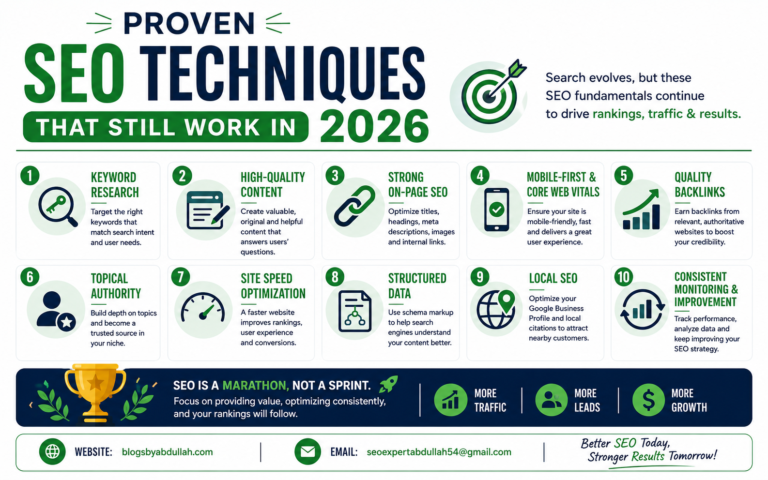
Your website needs to load fast, be easy to crawl, and work perfectly on mobile. These are not optional extras. They are the floor. Without a solid technical foundation, no amount of great content will save your rankings. Focus on Core Web Vitals, clean site architecture, proper internal linking, and a sitemap that Google can follow without confusion. If Google cannot read your pages easily, it cannot rank them.
Google wants to understand what your site is about. It ranks websites that consistently cover a topic in depth over websites that publish random content on unrelated subjects. This concept is called topical authority. Pick a topic area and own it completely. Write pillar content that covers the big questions. Then write supporting articles that go deep on every sub-topic. Link them together. Over time, Google begins to treat your site as a trusted source for that topic.
Links from other websites still matter. So do brand mentions, podcast appearances, press coverage, and reviews. Google uses all of these as signals to decide whether your site is trustworthy. The term for this is EEAT, which stands for Experience, Expertise, Authoritativeness, and Trustworthiness. Focus on earning genuine coverage rather than buying links. A feature in a respected industry publication is worth more than fifty links from low-quality directories.
This is the newest layer and the one most SEO guides are ignoring. It is called Generative Engine Optimization, or GEO. The goal is to get your content cited when AI tools answer questions related to your topic. AI systems like ChatGPT, Perplexity, and Google Gemini blend content from multiple sources when they generate answers. To get cited, your content needs to be clear, well-structured, and authoritative enough that AI tools trust it as a source.
Google made EEAT the core of its quality guidelines. It is not just about what you publish. It is about who you are and what others say about you. Experience means you have actually done the thing you are writing about. Expertise means you have deep knowledge in your field. Authoritativeness means others in your industry recognize you. Trustworthiness means your site is accurate, transparent, and honest. The way to build EEAT is not to simply claim these qualities on your About page. You build it by earning third-party proof. Go on podcasts. Get quoted in articles. Build genuine reviews. Publish original research. Show your real credentials on author pages.
Treat EEAT like social proof. Every mention, review, and citation that appears outside your own website is a vote of confidence that Google notices.
Keywords are still how you find demand. But ranking for a term does not mean it is the right term to target. You need to match the intent behind the search, not just the words.

The user wants to learn something. Example: how does SEO work. Content format: guides, explainers, how-to articles.
The user is looking for a specific website or brand. Example: Ahrefs login. Content format: homepage, brand pages.
The user is researching before they buy. Example: best SEO tools 2026. Content format: comparison articles, reviews, roundups.
The user is ready to take action. Example: buy Semrush subscription. Content format: product pages, landing pages, pricing pages. Map every piece of content you create to one of these intent types. Never mix them on the same page. A page trying to serve both informational and transactional intent usually fails at both.
GEO is not a replacement for traditional SEO. It is an additional layer built on top of it. In fact, AI tools tend to cite content that already ranks well on Google. So the best thing you can do for your AI search visibility is to get your fundamentals right first. That said, there are specific things you can do to increase your chances of being cited by AI platforms.
Near the top of every article, include a clear and concise answer to the main question. Keep it between 40 and 60 words. Write it in plain language without jargon. AI tools often pull this type of clean, direct answer when generating responses.
Schema markup tells AI systems and search engines exactly what your content is about. Use Article schema, FAQ schema, and HowTo schema where relevant. Research shows that content with proper schema markup gets 30 to 40 percent higher visibility in AI-generated results.
AI systems favor content that references credible sources and includes real data. Include statistics with proper attribution. Link to original research. Conduct your own surveys or studies if possible. Original data is one of the strongest signals that your content is worth citing.
AI platforms reference multiple websites when generating answers. The more your brand appears across different trusted sources, the more likely you are to be included. Earn coverage in industry publications. Participate in expert roundups. Get interviewed on podcasts. Every off-site mention increases your AI search visibility.
Share of Model, or SoM, is the new metric for AI search. It tracks how often your brand appears in AI-generated responses compared to your competitors. You can track this manually by running your target queries in ChatGPT, Perplexity, and Gemini and recording when your brand is mentioned. Dedicated GEO tools are also launching throughout 2026 to automate this tracking.
The goal of link building is no longer just to pass authority from one domain to another. It is about brand visibility. Every time your brand is mentioned, quoted, or linked to on a credible website, it sends a signal to both Google and AI platforms that you are a trustworthy source.
Create original research, data studies, or unique insights that journalists and bloggers want to write about. A single well-placed piece of original data can earn dozens of high-quality links naturally. This approach consistently delivers better results than manual outreach for links.
When users search your brand name alongside a keyword, such as your brand plus a product category, Google starts to associate your brand with that topic. Use social media, influencer partnerships, and content marketing to generate these branded searches. Growing your branded search volume tends to lift your rankings across all your target keywords.
Appearing on podcasts as a guest earns you a link from the podcast website, exposure to a new audience, and an EEAT signal that confirms your expertise. Many podcasts also publish show notes and blog posts that generate additional citations across the web.
Knowing what to avoid is just as important as knowing what to do. These tactics are either ineffective or actively harmful in 2026. Keyword stuffing and over-optimization will trigger quality penalties. Thin AI-generated content published at scale without human review is one of the fastest ways to lose rankings. Low-quality link exchanges and private blog networks are regularly targeted by Google algorithm updates. Ignoring Core Web Vitals and page speed slows down your progress across all keywords. Black hat attempts to manipulate AI systems, such as hiding instructions in content that prompt AI to cite your site, are being detected and penalized with increasing frequency.
Start by checking your website speed, mobile responsiveness, broken links, duplicate content, and overall SEO performance. Review your keyword rankings, analyze competitor strategies, and identify pages that need improvement. Fix technical SEO errors such as missing meta tags, poor URL structures, and indexing problems to help search engines crawl your site properly. This month creates the foundation for long-term success by ensuring your website is clean, optimized, and ready for better rankings, more traffic, and improved user experience.
Conduct keyword research focused on your core topic area. Map your existing content to the keyword gaps you find. Create new content for high-priority gaps. Update existing pages that are already ranking but have slipped or could rank higher with better depth and fresher information.
Focus on off-page signals. Reach out to publications, podcasts, and experts in your space. Implement schema markup across your main content pages. Add direct answer summaries to your top articles. Begin tracking your Share of Model score by manually testing your top queries in major AI platforms.
Yes. Google still drives the majority of online traffic globally. SEO remains one of the highest-return long-term marketing channels available. The strategy has evolved but the fundamentals of quality content, technical health, and genuine authority have not changed.
SEO optimizes for rankings in traditional search results. GEO optimizes for being cited in AI-generated answers from platforms like ChatGPT and Perplexity. AEO focuses on appearing in direct answer formats such as featured snippets and AI Overviews. A complete strategy in 2026 includes all three.
Technical fixes can show impact in days or weeks. Content SEO typically takes three to six months to build meaningful rankings. Authority and link-building results develop over six to twelve months. AI search citation visibility can appear within weeks for well-structured content on topics you already rank for.
Write clear direct answer summaries at the top of your articles. Implement FAQ and Article schema markup. Ensure your page already ranks on page one for your target query. Include original data and cite credible sources. AI Overviews heavily favor content that is already authoritative in traditional search.
Yes, but with a human editorial layer. AI tools are useful for research, outlines, and first drafts. Google rewards unique insights, lived experience, and genuine expertise that AI alone cannot produce. The best approach combines AI efficiency with human editing to add real perspective and EEAT signals.
Share of Model measures how often your brand is cited in AI-generated responses for your target queries compared to competitors. You can track it manually by running queries in ChatGPT, Perplexity, and Gemini and recording when your brand appears. Dedicated tools for automated SoM tracking are becoming available throughout 2026.
SEO in 2026 is not complicated. It has expanded, but the core idea has never changed. You find what people are searching for, you create the most helpful and trustworthy answer, and you make sure that answer is easy to find and easy to read. What is new is where people search. A growing number of users now start their queries in ChatGPT, Perplexity, or Google AI Overviews rather than clicking through ten blue links. If your content is not structured to be cited by these platforms, you are slowly becoming invisible to a large and growing audience. The brands and websites that will win in 2026 are the ones that do three things consistently. They build real authority by publishing content backed by genuine experience and third-party credibility. They keep their technical foundation clean so that both Google and AI systems can read and understand their pages without friction. And they adapt quickly when something in the search landscape shifts, rather than waiting until their traffic has already dropped. The biggest mistake you can make right now is to treat GEO and AI search as something to figure out later. Later is already here. Over 800 million people use ChatGPT every week. Perplexity and Gemini are growing fast. The window to establish authority in AI search before your competitors do is still open, but it will not stay open for long. Start with what you have. Run a quick audit. Fix what is broken. Update your most important pages with direct answer summaries and proper schema. Publish one strong piece of original content this month that demonstrates genuine expertise. Those four steps alone will put you ahead of most websites still running on a 2022 SEO playbook. SEO rewards consistency over intensity. You do not need to do everything at once. You need to do the right things regularly, measure what moves, and keep going. The sites that rank at the top of Google and get cited by AI tools did not get there in a week. They got there because someone committed to the process and did not quit. The search landscape will keep changing. New AI platforms will emerge. Google will release more updates. The tools will improve. But none of that changes the fundamental truth that has always been at the center of SEO: be the most helpful, most trustworthy, most clearly structured source for your topic and you will get found. That is as true in 2026 as it was in 2016. Build your strategy around that idea and you will never have to worry about the next algorithm update again.