
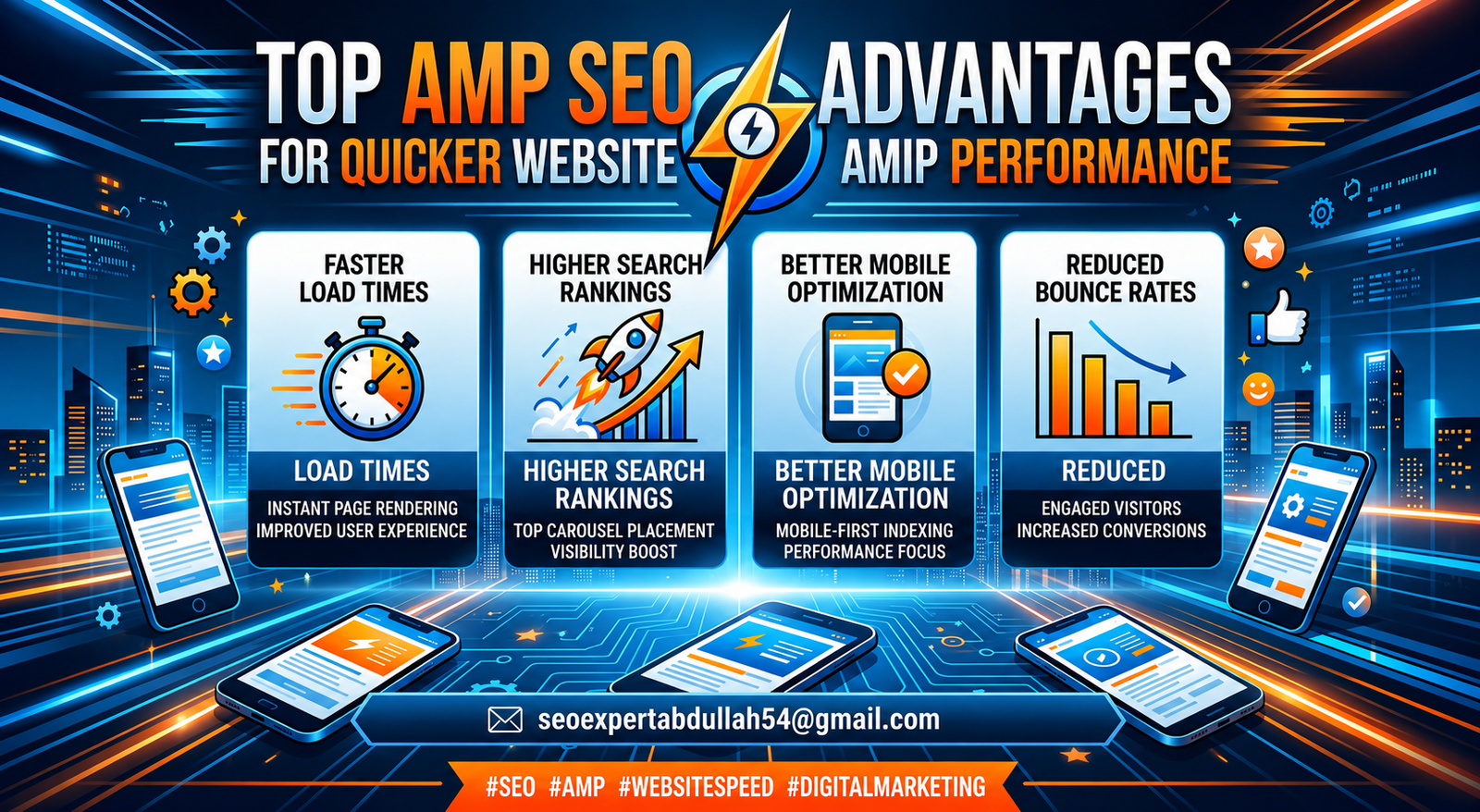
Conversion rates, organic traffic, and search engine exposure are all significantly impacted by mobile user experience. Accelerated Mobile Pages (AMP) is still an open-source framework that uses Google’s worldwide CDN caching network and eliminates heavy content to provide quick site loading on mobile devices.
An open-source web framework called AMP was developed to generate mobile-friendly websites that render very instantly. Strict development guidelines are enforced, giving top priority to asset pre-rendering, flawless content delivery, and site speed.

AMP removes render-blocking resources by enforcing inline style limits and asynchronous script execution. AMP-built pages usually load in less than a second, greatly enhancing Core Web Vitals metrics right out of the box.
User abandonment is directly correlated with page load latency. AMP reduces initial drop-offs and maintains user engagement on mobile landing pages by providing lightweight, instantly visible information.
Targeting mobile SERPs with customized AMP pages offers content a clear edge when conducting high-intent keyword research. Stronger click-through rates (CTR) are sometimes achieved by AMP pages being eligible for improved search capabilities like mobile rich cards and visual carousel formats.
Purchase weariness is eliminated by frictionless loading. Smooth transitions between browsing, viewing specs, and checkout increase the likelihood that users will fill up lead forms or make purchases.
Traffic spikes utilize a lot less origin server bandwidth and CPU resources since Google and third-party AMP caches serve validated articles straight from their servers.

The Direct Effect of AMP on CLS (Cumulative Layout Shift) and LCP (Largest Contentful Paint) By requiring important text and graphics to render asynchronously above the fold, AMP enhances Largest Contentful Paint (LCP). By demanding static dimensions (width and height) for each visual element prior to layout execution, it avoids Cumulative Layout Shift (CLS).
During breaking news events, high-volume publishers that publish timely stories benefit greatly from speed advantages, guaranteeing instantaneous information availability without server load.
Serving lightning-fast product display pages straight from search results helps eCommerce websites avoid drop-offs during impulsive purchases.
Fast-loading landing pages that convert local mobile searchers into phone calls and lead form submissions are advantageous for service-based companies and service providers targeting local SEO queries.
Setting Up Canonical Tags Correctly to Avoid Duplicate Content Problems Bidirectionally connecting non-AMP and AMP versions using canonical tags is essential to avoid duplicate content indexing because AMP generates an alternative version of an existing URL. Add an amphtml link tag that points directly to the AMP version URL on the Standard Non-AMP Page. A typical canonical link tag linking back to the main non-AMP desktop URL should be included to the AMP page. Keeping track of code and managing analytics on both AMP and non-AMP pagesIt is not possible for standard analytics tracking scripts to operate directly within AMP. To smoothly gather user sessions, event triggers, and conversion targets without violating page validation requirements, you must build the specific AMP Analytics component.
Install the official AMP plugin for WordPress. Configure theme styles, activate AMP for particular post kinds, and choose your preferred mode (Standard, Transitional, or Reader).
To automatically parse liquid or static templates into AMP-compliant sites, use native integration extensions or specialized third-party apps.
Create specialized AMP templates by hand using the standard AMP markup guidelines for specific tech stacks: To the main HTML tag, add the necessary AMP attribute. In the document head section, provide the required AMP JS library script.
An open-source web framework called AMP was developed to generate mobile-friendly websites that render very instantly. Strict development guidelines are enforced, giving top priority to asset pre-rendering, flawless content delivery, and site speed.
AMP is unnecessary if your development team can achieve superior Core Web Vitals performance with server-side rendering, headless architectures, or contemporary frontend optimizations. However, AMP continues to be one of the most dependable methods to ensure optimal mobile performance at scale if your website depends on complex CMS plugins.

No, AMP is not required for Google ranking or indexing. Regardless of the underlying technology, Google assesses site experience using performance indicators.
Mobile caching networks and mobile SERPs are the specific targets of AMP. Improvements in overall site speed have a good effect on site-wide quality ratings, even if they mainly affect mobile traffic performance.
The official AMP Test Web Tool, the Google Search Console AMP Status Report, or the AMP Validator Chrome plugin can all be used to validate your AMP sites.