A complete stack guide with real pricing, content gaps covered, ROI metrics, and everything your competitors are not telling you.
If you are in marketing right now, AI is not optional anymore. The brands growing fastest — Shopify, Airbnb, HubSpot, Canva — are not just experimenting with AI. They are building their entire marketing workflows around it.
But most guides online just throw a long list of tools at you and leave you confused. They do not tell you which tools to use together, how much they cost, or how to know if they are even working.
This guide is different. We cover the best AI marketing tools of 2026 across every category, show you how to build a proper stack, give you real pricing, and help you measure whether your tools are actually delivering results.
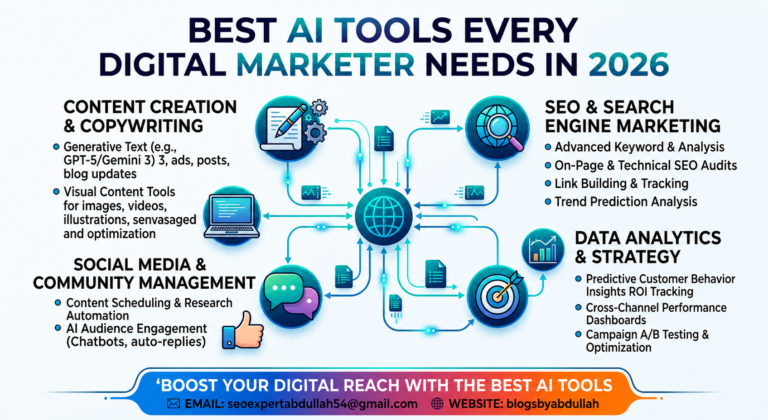
Discover the most powerful AI tools transforming digital marketing in 2026.from content creation to SEO optimization, these tools help marketers work smarter and faster.learn how AI can improve productivity, automate tasks, and increase campaign performance.explore platforms designed for social media management, email marketing, analytics, and design.Whether you are a beginner or an expert, AI tools can help you stay ahead of the competition.Save time, boost creativity, and generate better results with the latest marketing technologies.Find out which AI solutions every modern digital marketer should start using today.
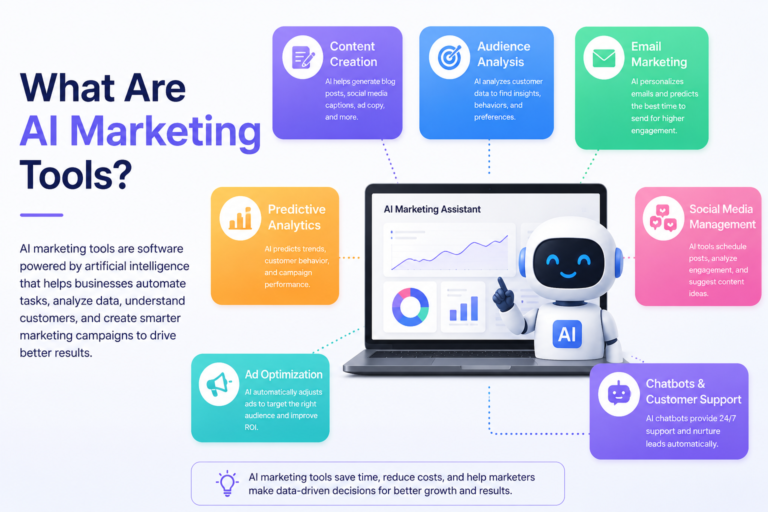
AI marketing tools are software platforms that use artificial intelligence and large language models like GPT-4, Claude, and Gemini to help marketers work faster, smarter, and at a much bigger scale than before.
These tools can write content, run ads, analyze competitors, automate workflows, generate images, personalize emails, and track performance — all with a level of speed and scale that was impossible just a few years ago.
The difference between traditional marketing software and AI tools is simple. Old software followed rules. If this happens, do that. AI tools actually think. They adapt to new information, generate original output, and make decisions based on patterns in data. In 2026, this is not about replacing marketers. It is about giving every marketer the output of a much bigger team.
Marketing cycles are faster than ever. Content demands are higher. Ad budgets are tighter. And your competitors are already using AI.
A task that used to take three hours now takes twenty minutes. Blog posts, ad variations, competitor reports, email sequences all of it moves faster with AI.
You can produce more content, run more ad tests, and reach more audiences without hiring more people.
AI tools analyze customer behavior and create experiences that feel custom-built for each individual user, which improves conversions.
Predictive analytics tools give you insights before your competitors catch on. You make better decisions because you have better data.
Done right, AI reduces the cost per piece of content, per lead, and per campaign significantly.
Most people make a mistake here. They see a list of fifty tools and start signing up for everything. Then they end up paying for six tools that overlap and solving no real problems.
Build your stack intentionally. Start by mapping your marketing funnel and asking where your biggest bottlenecks are. If you spend too much time writing content, start with a writing and SEO tool. If your ads are not converting, start with an ad optimization tool. If you have no idea what is working, start with an analytics or competitor intelligence tool.
One LLM like Claude or ChatGPT, one SEO tool like Surfer, and one automation tool like Zapier. That covers 80 percent of daily needs for under 80 dollars a month.
Add a social media or video tool, a competitor research tool, and a basic CRM with AI features like HubSpot to the solo stack.
Dedicated platforms for every category below, plus a digital asset management system to keep all content organized and on-brand at scale.
The goal is not to have the most tools. The goal is to have the right tools that talk to each other and cover your real workflow gaps.
Automation tools are the backbone of any modern marketing stack. These are the tools that connect everything else together and handle the repetitive work automatically.
Gumloop is the best no-code AI automation tool right now. Think of it like Zapier but with real AI intelligence built into every step. You can connect any LLM like Claude or ChatGPT to your internal tools and workflows without writing any code. Teams at Shopify, Webflow, and Instacart use it internally. Premium AI models are included so you do not need your own API keys, and it runs continuous AI agents that work in real time on new data.
Best for: AI marketing workflows, competitor intelligence automation, content pipeline automation
Starting price: Free plan available, paid from around 30 dollars per month
Zapier has been the default automation tool for years, and its AI layer makes it significantly more powerful. It now understands conditional logic, can clean and reformat messy inputs, and maps data between platforms automatically.
Best for: Connecting existing apps, automating email campaigns, syncing data across CRM and ad tools
Starting price: Free plan, paid from 20 dollars per month
n8n is the choice for technical teams who want full ownership. It is open-source and self-hostable, which makes it ideal for companies in regulated industries or anyone who needs complete control over data privacy.
Best for: Enterprise teams with a developer, data-sensitive workflows, complex custom automations
Starting price: Free self-hosted, cloud from 24 dollars per month
Content is still the biggest time sink in marketing. These tools handle the heavy lifting of drafting, editing, and scaling written content.
Claude is the best AI for long-form thinking and complex marketing strategy. If you have large documents to analyze, dense content briefs to process, or multi-step strategy plans to build, Claude handles it better than most other models. It is contextual, careful, and extremely strong at understanding nuanced prompts.
Best for: Content strategy, editing, research synthesis, building editorial calendars, marketing analysis
Starting price: Free tier, paid from 20 dollars per month
Jasper is one of the most mature AI writing platforms built specifically for marketers. It is strong on branded writing — consistent tone, templates for ads, blog posts, landing pages, and email sequences. If you need a writing system for a whole content team, Jasper is worth the investment.
Best for: Marketing teams needing brand-consistent content at volume
Starting price: From 39 dollars per month
ChatGPT is the tool most people open first every day, and for good reason. It is flexible, conversational, and genuinely excellent for ideation, rough drafts, persona simulation, and quick copy tasks.
Best for: Brainstorming, daily copy tasks, customer persona testing, email drafting
Starting price: Free, paid plans from 20 dollars per month
Writer is the enterprise-grade choice. It maintains brand voice rules at scale, integrates with Google Docs, Notion, and most CMS platforms, and is built specifically for teams that need consistency across large content libraries.
Best for: Enterprise content teams, regulated industries, brand governance at scale
Starting price: From 18 dollars per user per month
Copy.ai is fast and flexible, with one standout feature for sales-focused marketers — it can analyze a lead list, research each prospect, and write personalized cold emails automatically.
Best for: Outbound sales content, fast short-form copy, lead nurturing sequences
Starting price: Free tier, paid from 36 dollars per month

Getting content to rank requires more than good writing. These tools optimize your content specifically for search engines.
Surfer SEO analyzes live search data, competitor content, keyword density, and structure, then gives you an SEO blueprint that guides your writing in real time. As you write, your SEO score updates live so you always know where you stand.
Best for: Optimizing individual blog posts and articles before publishing
Starting price: From 89 dollars per month
Clearscope is laser-focused on one outcome — higher-ranking content. It analyzes top-performing search results and distills them into keyword suggestions, readability targets, and content structure patterns.
Best for: Content writers and editors who want to improve search depth without complexity
Starting price: From 170 dollars per month
Ahrefs is the gold standard for SEO research. It maps not only what your site ranks for, but what competitors rank for that you do not — which alone can generate weeks of strategic content ideas.
Best for: Keyword research, backlink analysis, content gap discovery, rank tracking
Starting price: From 129 dollars per month
Semrush is a full-suite competitor intelligence and SEO platform. Strong for all-in-one tracking across keywords, backlinks, paid ads, and social media performance.
Best for: Teams who want one platform for SEO, PPC research, and competitive tracking
Starting price: From 139 dollars per month
Visual content and short-form video are now the highest-engagement formats across every platform. These tools make production fast and scalable.
Kling AI is a full creative studio for AI video generation. It lets you create realistic video content from text prompts and images. Many of the top-performing AI video ads running on social media right now were created with Kling AI.
Best for: AI video ad creation, short-form video content, product visualization
Starting price: Free tier available, paid from 9 dollars per month
OpusClip takes your long-form videos and automatically finds the most engaging moments to turn into short clips for Instagram Reels, TikTok, and YouTube Shorts. It detects punchlines, emotional moments, and high-energy segments automatically.
Best for: Repurposing podcast content, webinars, and long YouTube videos
Starting price: Free tier, paid from 15 dollars per month
Canva was already everywhere. With AI, it now generates copy inside templates, removes unwanted objects from photos, suggests layouts, and resizes assets for every platform automatically.
Best for: Social content, presentation decks, ad creatives, on-brand visual assets
Starting price: Free tier, paid from 15 dollars per month
Midjourney produces the most artistic and stylized AI images available. Give it a detailed prompt and it generates visuals that look like they came from a premium creative studio.
Best for: Brand mood boards, editorial imagery, creative campaign concepts
Starting price: From 10 dollars per month
Synthesia lets you type a script, choose an AI presenter, and get a professional video back — no camera, no actor, no editing required. Ideal for repeatable video formats like explainers, training content, or product walkthroughs.
Best for: Corporate communications, e-learning, product demo videos at scale
Starting price: From 29 dollars per month

Data is only useful if it tells you what to do next. These tools surface insights faster and more clearly than traditional analytics dashboards.
Perplexity reads the web for you and returns clean, cited summaries instead of just a list of links. It is one of the fastest ways to do market research, track industry news, or understand what competitors are doing.
Best for: Real-time market research, trend tracking, quick competitive summaries
Starting price: Free, paid from 20 dollars per month
Crayon automatically monitors competitors across the web — tracking website changes, pricing updates, messaging shifts, and new product launches. Instead of manual screenshots and bookmarks, Crayon keeps an always-on eye on your competitive landscape.
Best for: Product marketers, competitive intelligence teams, enterprise brand strategy
Starting price: Custom pricing, typically mid to enterprise range
SimilarWeb provides traffic data, audience demographics, top keywords, and engagement metrics for any website. Its AI layer makes it faster to surface decision-relevant insights from all that data.
Best for: Market entry research, benchmarking, audience geography analysis
Starting price: Free limited tier, paid plans from 125 dollars per month
Brand24 monitors mentions of your brand, competitors, and industry keywords across social media, news, blogs, and forums in real time. It uses AI to detect sentiment, flag emerging reputation risks, and surface positive PR opportunities.
Best for: Brand monitoring, reputation management, influencer identification
Starting price: From 79 dollars per month
Running ads at scale requires testing, optimization, and personalization that no human team can manage manually. AI ad tools handle this automatically.
Albert AI is a fully autonomous paid media optimization platform. It manages budget allocation, bid optimization, creative testing, and audience targeting across channels — adjusting in real time based on performance data.
Best for: Teams running paid ads across multiple channels who want automated optimization
Starting price: Custom enterprise pricing
Persado uses AI to test and refine ad copy at an emotional level — analyzing which words, tones, and messages trigger the highest response from specific audience segments.
Best for: Performance marketers wanting to improve ad copy conversion rates
Starting price: Enterprise, custom pricing
Performance Max is Google’s AI-driven campaign type that automatically shows ads across Search, Display, YouTube, and Gmail based on your goals and creative inputs. It requires minimal manual management and uses machine learning to find the best-performing combinations.
Best for: Businesses running Google Ads who want maximum reach with automated optimization
Starting price: Pay per click, no minimum spend required
For teams that can only choose two tools — Claude plus Surfer SEO is the highest-value combination for content-focused marketers.
This is the part every guide skips. You chose your tools. You set them up. Now how do you know they are actually delivering value? Track these five metrics from day one.
How long does it take to go from brief to published content? A good AI writing stack should reduce this by at least 40 to 50 percent within the first month.
Divide your total content costs by the number of pieces published. This number should go down as AI handles more of the drafting work.
For SEO tools, track keyword rankings and organic sessions month over month. Expect three to six months before SEO-focused AI work shows meaningful results.
For paid tools, track return on ad spend before and after implementation. Albert AI and Performance Max users typically see improvements within the first 30 to 60 days.
Ask your team each month how many hours the AI tools are saving them. Multiply that by their hourly cost. That is your ROI number in clear dollars.
Run a 30-day audit at the end of each month. Check which tools you actually used. Cut anything with zero clear impact. Reinvest that budget into tools that are working.
This is a topic most marketing guides completely ignore. But as AI tools become central to your marketing operation, these risks are real and worth knowing.
Make sure every AI tool you use is compliant with GDPR, CCPA, and any regulations that apply in your market. Check where your data is stored, whether it is used to train models, and what the data retention policy is. This matters especially for tools connected to your CRM or customer data.
Google does not penalize AI-generated content simply for being AI-generated. What it penalizes is low-quality, unhelpful content. Always fact-check AI output, add original insights, and edit for accuracy before publishing. Do not publish raw AI drafts.
AI ad targeting systems can sometimes reinforce demographic biases based on historical data. Review audience segmentation regularly, especially for any ad sets that could exclude or unfairly target specific groups. This is both an ethical issue and a legal one in some markets.
AI tools trained on general internet data do not automatically know your brand voice. Build clear brand guidelines into every tool that produces content. Use platforms like Writer or Jasper’s brand voice features to maintain consistency.
For the vast majority of tools on this list, no technical skills are required at all. Platforms like Claude, Canva AI, Surfer SEO, OpusClip, and Gumloop are built for non-technical users with visual interfaces and plain-language inputs. The only exception is n8n, which works best if you have access to a developer or have some familiarity with APIs. Everything else is designed to be picked up in an afternoon.
Not if you use it correctly. Google's official stance is that AI-generated content is not penalized simply for being AI-generated. What gets penalized is thin, low-quality content that provides no real value to readers. The best approach is to use AI for the draft and heavy lifting, then have a human add original insights, first-hand expertise, and fact-checks before publishing. Content that is useful, accurate, and well-structured will rank — regardless of how it was produced.
Two to three tools is the right number for most small businesses. A strong LLM like Claude or ChatGPT covers writing, ideation, and strategy. An SEO tool like Surfer covers content optimization. And a simple automation tool like Zapier connects your workflows. Beyond that, add tools only when you have a specific bottleneck that the new tool directly solves. The goal is a tight, integrated stack — not the most subscriptions.
Both are excellent, and many marketers use both. Claude tends to be stronger for long-form analysis, nuanced strategy documents, and careful editing — it handles large amounts of context particularly well and produces writing that feels more considered. ChatGPT is highly flexible, excellent for rapid brainstorming, persona testing, and conversational tasks. If you do a lot of structured content strategy work, Claude often feels better suited. If you need fast, iterative ideation and copy, ChatGPT is a natural fit. The honest answer is that trying both on your actual work is the best way to decide.
It depends on the category. Content speed and cost savings are usually visible within the first two weeks — you will notice immediately how much faster drafts move. Automation and workflow savings show up within the first month. SEO results take the longest: expect three to six months before content optimized with tools like Surfer or Clearscope shows meaningful ranking gains. Ad tools like Albert AI and Performance Max typically improve ROAS within 30 to 60 days once the system has enough data to optimize against.
It varies by tool, so you have to check the terms of each platform you use. The key questions to ask are: does the tool use your inputs to train its AI models, where is your data stored and in which jurisdiction, what is the data retention policy, and does it have SOC 2 compliance or equivalent security certifications? For tools connected to your CRM or customer database — where real personal data flows — this due diligence is not optional. Most enterprise-tier tools offer data processing agreements that explicitly prevent your data from being used for model training.
Not fully, and trying to go that route tends to backfire. AI tools are exceptionally good at the production layer — drafting, formatting, optimizing, repurposing. They are not good at original thought leadership, genuine brand perspective, nuanced audience relationship building, or editorial judgment that comes from real experience in your market. The best-performing content teams in 2026 use AI to do more, faster — not to eliminate the humans who bring genuine insight, taste, and accountability to what gets published.
For visual content and design, Canva AI is the most practical choice for most teams. For short-form video from existing content, OpusClip is outstanding. For original AI video ads and creative campaigns, Kling AI leads the field right now. For the copy itself — captions, hooks, calls to action — any strong LLM like Claude or ChatGPT works well. Most social media teams end up combining two or three of these: one for visuals, one for video, and one for copy generation and variation testing.
After covering every major category of AI marketing tool in 2026, a few clear patterns emerge that are worth keeping in mind before you close this guide and start evaluating tools.
The AI marketing landscape is no longer experimental. The tools are mature, the pricing is accessible, and the results are measurable. What separates the marketers getting real lift from AI and those still chasing shiny new releases is not budget or access — it is how intentionally they build and manage their stack.
The biggest mistake is treating AI tools like a collection of features to unlock rather than a system to build. A well-connected stack of three tools that share data and complement each other will outperform a disjointed pile of twelve subscriptions every time. Integration matters more than variety.
The second mistake is expecting AI to replace judgment. The tools on this list are extraordinarily good at production — drafting, optimizing, distributing, and automating. They are not good at knowing what your audience genuinely cares about, what your brand actually stands for, or when to hold back and when to push. That still requires a human with context and experience. The best use of AI is to free that human up to do more of that work, not less.
Start With Your Bottleneck — Identify the single biggest time sink in your workflow today and pick one tool that directly solves it. Master that before adding anything else.
Measure From Day One — Set a baseline before you start — time, cost, output volume, ROAS, traffic. You cannot know if a tool is working unless you know where you started.
Audit Every 30 Days — Cancel what you are not using. Reinvest that budget into what is delivering. A lean, active stack always beats a bloated, ignored one.
AI marketing is not about being the first to try every new tool. It is about building a reliable system that makes your marketing better, more consistent, and more efficient over time. That kind of compound advantage does not come from chasing releases — it comes from committing to a thoughtful stack and iterating on it.
The marketers winning in 2026 are not the ones with the most tools. They are the ones who learned a smaller number of tools deeply, connected them well, and kept their focus on what they have always needed to focus on: creating something worth paying attention to.
Start Small and Build Up
The most important thing is not to have the biggest AI stack. It is to have the right tools solving your actual problems.
Start with one or two tools in the areas where you lose the most time. Learn them well. Measure their impact. Then add the next layer.
The marketers who will win in 2026 are not the ones who signed up for every new tool. They are the ones who used a focused stack consistently, measured what worked, and kept improving their system over time.
AI marketing is not a replacement for strategy, creativity, or genuine human insight. It is a multiplier for all three. Use it that way and the results will follow.