
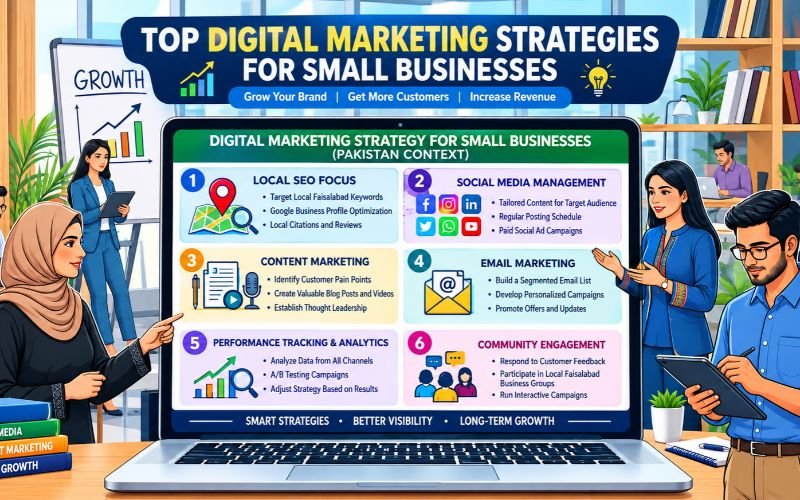
Large brands have big budgets, but small businesses have agility, personality, and local knowledge. With the right small business online marketing strategies, you can reach the exact people who need your product without spending millions. A well-optimized Google listing or a smart Facebook ad can bring in customers at a fraction of traditional advertising costs.
SEO helps your website appear when people search for what you sell. Start with keyword research to understand the phrases your customers use. Then place those keywords naturally in your page titles, headings, meta descriptions, and content. Also make sure your site loads fast, works well on mobile, and is easy to navigate. Search engines reward websites that give visitors a smooth experience.
For local digital marketing for small business, your Google Business Profile is your most powerful free tool. Claim your listing and fill in every detail: business name, address, phone number, hours, services, and photos. Choose accurate categories and add a short description with relevant keywords. Encourage happy customers to leave reviews and reply to every one. A complete, active profile helps you show up in the local map results where nearby customers are ready to buy.
People buy from businesses they trust. Blog posts, how-to guides, and FAQs show your expertise and answer customer questions before they even contact you. A plumber can write about preventing winter pipe damage, and a bakery can share cake-storage tips. Useful content attracts search traffic, builds authority, and gently guides readers toward becoming customers.
Facts inform, but stories connect. Share why you started your business, how you solve customer problems, and the real results you’ve delivered. Customer success stories and behind-the-scenes posts make your brand feel human. This emotional connection is something large corporations struggle to copy.
You don’t need to be everywhere. Choose platforms where your audience actually spends time. Visual businesses like fashion, food, and beauty thrive on Instagram and TikTok. Service providers and B2B companies often do better on LinkedIn. Local shops can build strong communities on Facebook. Focus on one or two platforms and do them well.
Consistency builds recognition. A simple content calendar helps you plan posts in advance, balance promotional and educational content, and avoid last-minute stress. Even three to four quality posts a week is better than posting daily for a week and then disappearing. Use scheduling tools to save time, and spend a few minutes each day replying to comments and messages.
Email gives you a direct line to your customers, with no algorithm in between. Grow your list by offering a discount, checklist, or free guide in exchange for an email address. Then segment your subscribers by interest, location, or purchase history. A message that feels relevant gets opened far more often than a generic blast.
Automation lets you stay in touch without doing everything by hand. Set up a welcome email that introduces your brand, followed by a short series that shares helpful tips, customer stories, and a gentle offer. Add reminders for abandoned carts or upcoming appointments. Once built, these sequences work around the clock
Google Search Ads put you in front of people actively looking for your service. Start with a small daily budget, target specific keywords, and add negative keywords to avoid wasted clicks. Write clear ad copy and send visitors to a focused landing page with one obvious call to action. Monitor results weekly and pause anything that isn’t performing.
Facebook and Instagram ads let you target people by location, age, interests, and behavior. A restaurant can show offers to people within five kilometers, and a salon can promote to women in a specific age group nearby. Test two or three ad versions, keep your budget modest, and scale up what works. This is one of the best online marketing for small business options when budgets are tight.
Start with specific, measurable goals, such as “get 30 new leads per month” instead of “grow online.” Then create audience personas: who your customers are, what they struggle with, where they spend time online, and what influences their buying decisions.
Review your website, social profiles, listings, and email list. What’s working and what’s outdated? Study two or three competitors too. Look at their content, reviews, and ads to spot gaps you can fill.
Decide who handles content, social media, email, and reporting. Even if you’re a solo owner, set aside fixed time slots each week. Clear workflows keep your marketing steady instead of random.
Focus on metrics that connect to revenue: website visitors, leads generated, conversion rate, cost per lead, and customer acquisition cost. Vanity numbers like likes mean little unless they lead to sales.
Use Google Analytics and Google Search Console to see where visitors come from, which pages they view, and where they leave. Your conversion rate, the percentage of visitors who take action such as calling, booking, or buying, shows whether your website is doing its job.
To calculate ROI, subtract your marketing cost from the revenue it generated, then divide by the cost. Also watch engagement signals like comments, shares, email click rates, and saves. Together, they show what your audience truly values.
Trying every platform at once usually means doing none of them well. Pick two or three channels that suit your audience, master them, and expand only when you see consistent results.
Most local searches happen on phones. If your website is slow or hard to use on mobile, or your business details differ across directories, you lose customers to competitors. Keep your name, address, and phone number consistent everywhere, and test your site on a smartphone regularly.
A common guideline is 5% to 10% of your revenue, though new businesses may invest more to build awareness. Start small, track results, and increase spending on channels that deliver.
Paid ads, especially Google Search Ads and Meta Ads, usually deliver the quickest results, often within days. SEO and content marketing take longer, typically three to six months, but offer lasting, lower-cost growth.
Set up your Google Business Profile, create a free social media presence, publish helpful content, collect customer reviews, and build an email list with a free tool. Time and consistency can replace money in the early stages.
Success in digital marketing comes from smart, consistent action, not a huge budget. Start with local SEO, add valuable content, engage your audience on the right platforms, and test paid ads carefully. Track your numbers, learn from them, and improve step by step.