
Most content published online never gets seen by anyone. Not because it is bad writing but because it was never built to rank. Google receives billions of searches every day and only the top few results get most of the clicks. If your content is not on page one it is basically invisible.
This guide will show you exactly how to create SEO optimized content from scratch. You will learn how to pick the right keywords, match what the searcher actually wants, choose the right content format, write with authority, optimize every on page signal, add schema markup, handle technical SEO, use AI tools responsibly, measure results, and keep your content fresh over time.
This is a complete system. Not a list of random tips. Every step builds on the one before it. Follow it and your content will have a real shot at ranking.
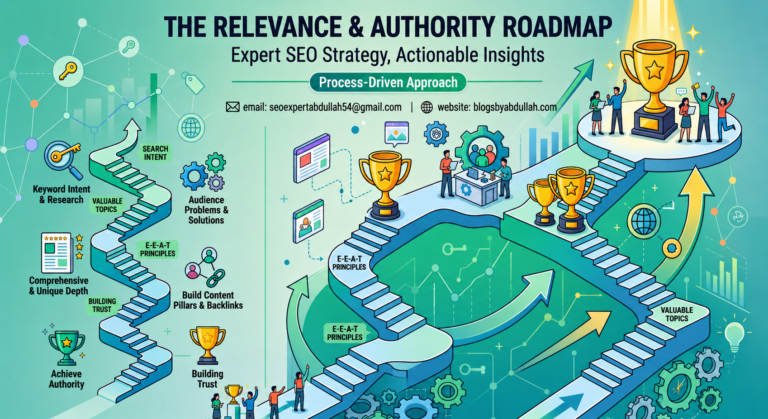
Good content marketing not only improves your online presence but also helps your website rank higher on search engines like Google. By providing useful and engaging information, businesses can connect with customers naturally and grow long-term relationships.
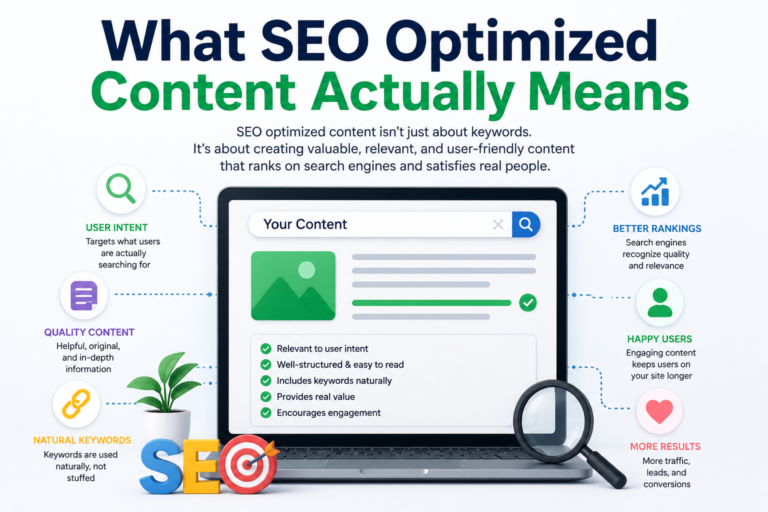
SEO optimized content is content written to serve two goals at the same time. First it has to be useful and clear for real human readers. Second it has to be structured and signaled in a way that Google can understand and trust.
Most people get one of these right but not both. Some write great articles but ignore every technical signal. Others stuff their pages with keywords but produce content no one wants to read. Neither approach works anymore.
Google has become very good at understanding what makes content genuinely useful. It rewards pages that answer questions fully, demonstrate real knowledge, and provide a good reading experience. So the goal is not to trick the algorithm. The goal is to create something truly worth ranking.
Keyword research is the foundation of everything. If you target the wrong keyword you can write a perfect article and still get zero traffic. The right keyword is one that people are actually searching for, that matches what your content can genuinely answer, and that you have a realistic chance of ranking for.
Start by thinking about your topic from the searcher’s perspective. What exact words would someone type into Google if they had the problem your content solves? Go beyond the obvious head terms and look for longer, more specific phrases. These are called long tail keywords and they are usually easier to rank for because fewer sites have targeted them directly.
Two numbers matter most in keyword research. Search volume tells you how many people search for a term each month. Keyword difficulty tells you how hard it is to rank for that term based on how strong the competing pages are.
The sweet spot is a keyword with decent volume and low enough difficulty that you can actually compete. A keyword with 500 monthly searches and low difficulty is far more valuable than one with 10,000 searches that only major sites rank for. Use tools like Google Keyword Planner, Ahrefs, Semrush, or LowFruits to find these opportunities.
Modern SEO is not about repeating one keyword over and over. Google uses natural language processing to understand what a piece of content is really about. That means you need to include related terms, synonyms, and topic variations that a knowledgeable writer would naturally use.
For example an article about coffee brewing should naturally include terms like water temperature, grind size, extraction time, and pour over without having to force them in. These semantic signals tell Google your content covers the topic comprehensively rather than just targeting a single phrase.
Search intent is the reason behind a search query. Google prioritizes content that matches the intent of the searcher. If you mismatch intent your content will struggle to rank no matter how well written it is. Informational intent means the person wants to learn something. Navigational intent means they are looking for a specific website or brand. Transactional intent means they are ready to buy. Commercial intent means they are comparing options before buying. Most blog content targets informational intent.

The easiest way to check intent is to search your target keyword in Google and look at what ranks. Are the top results blog posts, product pages, videos, or listicles? The dominant content type tells you what Google believes users want. Match that format and you are already aligned with the algorithm.
Also look at the People Also Ask boxes and related searches at the bottom of the page. These show you the sub questions users have around the topic. Answering them in your content helps you capture more of the search traffic and increases your chances of appearing in featured snippets.
One of the biggest mistakes content creators make is defaulting to the same format for every article. The right format depends on the keyword, the intent, and what is already ranking. Here is a simple way to decide.
If the keyword is a how to question write a step by step guide. If it is a best of question write a listicle or comparison post. If it is a definition or explanation question write a comprehensive informational guide. If the SERP shows video results consider making a video with a supporting written transcript.
Long form blog posts are the most versatile SEO content format. They work well for informational keywords where the user wants a thorough answer. The ideal length depends on the competition. If top ranking pages average 1800 words write something more complete. If they average 800 words a longer article will not necessarily win. Relevance and depth matter more than raw word count.
Step by step guides rank extremely well for instructional queries. They work because they directly match the intent of someone who wants to do something specific. Use numbered steps, keep each step clear and actionable, and include practical examples wherever possible. A well structured tutorial also has a high chance of appearing in featured snippets which can dramatically increase clicks.
Listicles perform well because they are easy to scan and promise a clear structure upfront. The title tells the reader exactly what they are getting. Make sure each item on your list is genuinely explained rather than just named. Thin listicles that only list things without explaining them do not rank well because they do not actually serve the reader.
Infographics work best for simplifying complex data or processes. They earn backlinks naturally because other sites use them as references. For SEO value always publish the infographic inside a well written article and include descriptive alt text on the image. The text around the infographic is what Google reads. The image itself is just a visual aid.
Video is increasingly showing up in Google search results. Creating a video version of your written content gives you a chance to rank in both Google Search and YouTube. For SEO always include a written transcript or summary below the video. This gives Google text content to index while the video serves viewers who prefer watching.

E-E-A-T stands for Experience, Expertise, Authoritativeness, and Trustworthiness. Google uses these signals to evaluate whether your content deserves to rank, especially for topics that affect health, money, safety, or major life decisions. But these signals matter across almost every niche now. Experience means you have actually done the thing you are writing about. Expertise means you know the subject deeply. Authoritativeness means your site and your name are recognized in your field. Trustworthiness means your content is accurate, honest, and transparent.
Share specific details that only someone with real experience would know. Include your own results, screenshots, case studies, or examples from your actual work. Avoid writing in vague generalities. The more concrete and specific your content the more it reads like it came from someone who has actually done the thing.
Every article should have a visible author name linked to a bio page. The bio page should clearly state the author’s credentials, experience, and relevant background. This is one of the clearest signals to Google and to readers that a real expert wrote the content. If the article has been reviewed by another expert mention that too.
Link out to reputable studies, official statistics, and credible sources. This does two things. It makes your content more trustworthy for readers and it signals to Google that your content is grounded in verifiable information. You do not need to cite every sentence but major claims should be supported with a source.
A single great article is not enough to dominate a topic. Google rewards websites that cover a subject comprehensively across multiple pages. This is called topical authority. The way to build it is through a content cluster model. You create one large pillar page that covers a broad topic at a high level. Then you create multiple supporting articles that go deep on specific subtopics. Each supporting article links back to the pillar and the pillar links out to each supporting article. For example if your pillar page is about content marketing you might have supporting articles on keyword research, on page SEO, content refresh strategy, internal linking, and so on. Over time this network of related content tells Google your site is an authoritative resource on the whole subject area.
Your title tag is the single most important on page SEO element. It tells Google and searchers exactly what your page is about. Include your primary keyword near the beginning of the title. Keep it under 60 characters so it does not get cut off in search results. Make it compelling enough that someone would actually want to click it. The meta description does not directly affect your ranking but it affects your click through rate which does. Write a description of 150 to 160 characters that summarizes your content, includes the keyword naturally, and gives the searcher a clear reason to click. Think of it like an ad for your article.
Your URL should be short, lowercase, and descriptive. Use your primary keyword in the URL and separate words with hyphens. Avoid numbers, dates, or random characters. A clean URL like yourdomain.com/seo-optimized-content is better than yourdomain.com/post123 for both SEO and user trust.
Use one H1 per page that contains your primary keyword. Use H2 headings for major sections and H3 headings for subsections within those sections. This structure helps Google understand the hierarchy of your content and helps readers navigate quickly to the section they care about most.
Include your primary keyword in the first 100 words of your article, in the H1, in at least one H2, in the meta description, and in the URL. Use it naturally a few more times throughout the body. Do not repeat it artificially. Write for the reader and the keyword will appear where it makes sense.
Every image needs descriptive alt text that explains what the image shows. Name your image files descriptively before uploading them. Compress your images to reduce file size without sacrificing quality. Use WebP format where possible as it loads faster than JPEG or PNG. Slow loading images hurt both user experience and rankings.
Google indexes the mobile version of your site first. That means your content needs to be easy to read on a phone. Keep paragraphs to three or four sentences maximum. Use short sentences. Put important information at the top. Make sure tap targets like buttons and links are large enough to press easily on a small screen.

Schema markup is code you add to your page that helps Google understand exactly what type of content you have published. It does not guarantee a ranking boost but it makes your content eligible for rich results like FAQ boxes, how to steps, and star ratings that appear directly in search results. Rich results increase your visibility and click through rate even if your ranking position stays the same. A page with FAQ rich results takes up more space in the SERP and draws more attention than a plain blue link.
Article schema tells Google this is a news or informational article and allows you to specify the author, publish date, and modification date. FAQ schema marks up question and answer content so Google can display the questions directly in search results. HowTo schema marks up step by step instructional content and can appear with numbered steps in the SERP.
You can implement schema without any coding knowledge using free tools like Google’s Structured Data Markup Helper or plugins like Yoast SEO or Rank Math if you use WordPress. Always validate your schema using Google’s Rich Results Test tool after adding it.
Core Web Vitals are a set of performance metrics Google uses as a ranking signal. The three main ones are Largest Contentful Paint which measures how fast the main content loads, Cumulative Layout Shift which measures visual stability, and Interaction to Next Paint which measures responsiveness to user input. As a content creator you may not control the underlying code but you can influence these scores. Compress your images, avoid embedding large video files directly in the page, and do not use auto playing media that shifts the layout. Check your Core Web Vitals scores in Google Search Console and flag any issues to your developer.
If Google cannot crawl and index your page it will never rank regardless of how good the content is. Make sure your page is not blocked in your robots.txt file. Check that the page has a proper canonical tag pointing to itself. Submit the URL in Google Search Console after publishing to request faster indexing. Also check that all the internal links pointing to this page are working correctly and that the page is reachable within a few clicks from your homepage. Pages buried deep in a site structure get crawled less frequently and indexed more slowly.

Google does not penalize content for being written with AI assistance. What Google penalizes is low quality, unhelpful, or spammy content regardless of how it was produced. The question Google asks is not whether AI was used. The question is whether the content is genuinely useful to the person who searched for it.
AI tools are useful for generating first drafts, outlining, brainstorming related questions, and checking for gaps. They are not useful for producing publish ready content without human review. AI often produces content that is generic, factually imprecise, or missing the real world experience that makes content trustworthy. Always edit AI generated drafts heavily. Add your own knowledge, specific examples, accurate data, and a human voice. Make sure every factual claim is verified. The human editing pass is what takes AI output from mediocre to genuinely helpful. That editing is also what builds E-E-A-T signals.
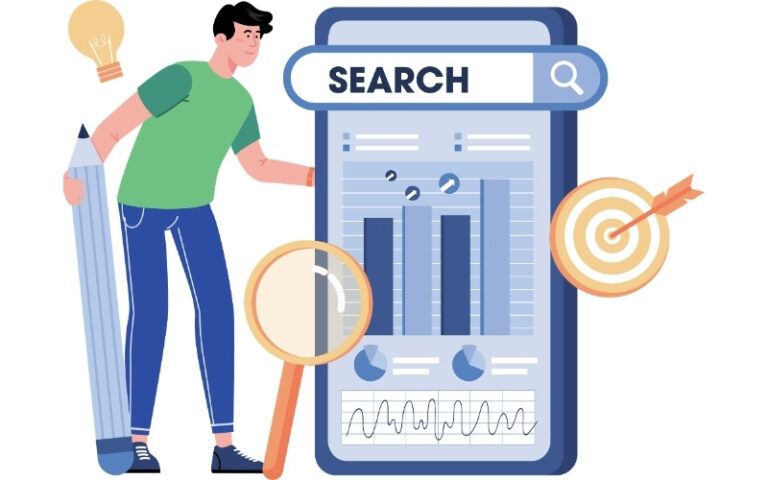
After publishing, use Google Search Console to monitor impressions, clicks, average position, and click through rate for each page. Impressions tell you how often your page appeared in search results. Clicks tell you how many people actually visited. Average position tells you where you are ranking. Click through rate tells you what percentage of people who saw your result clicked on it. In Google Analytics track engagement metrics like average time on page and bounce rate. If people are leaving immediately after arriving your content may not be matching their intent well. If they are spending several minutes reading you are on the right track. When to Take Action If a page has high impressions but low clicks your title tag or meta description needs work. If a page has good clicks but high bounce rate your content may not be delivering what the title promised. If a page is getting clicks and engagement but not converting readers into customers your calls to action need attention. Give new content at least three to six months before drawing conclusions. SEO results take time. But if a page shows no impression growth after six months it is worth revisiting the keyword targeting, content quality, and internal linking.
Content that ranks today may not rank six months from now. Industries change. Statistics become outdated. New competitors publish better resources. Google updates its algorithm. All of these forces can push a once strong page down in the rankings over time. The good news is that updating existing content is one of the highest return activities in SEO. A page that already has backlinks and some ranking history only needs new depth and freshness to regain or improve its position. It is often faster to update an existing article than to write a new one from scratch.
Go into Google Search Console and sort your pages by impressions over the past three months compared to the three months before. Pages where impressions have dropped are your priority refreshes. Also look for pages ranked between position 5 and 20. These are close to the top and a quality update can push them into the top three which dramatically increases clicks.
Update any statistics, dates, or examples that are no longer accurate. Add new sections covering subtopics that competitors now cover but your original article missed. Improve the introduction to hook readers faster. Add better images or visuals. Strengthen the internal linking. Update the publish date only after making genuine content improvements not just minor edits.
Once you have a strong piece of content you can extend its reach by repurposing it into other formats. Turn a long guide into a video script and publish it on YouTube. Turn the key points into a carousel post for LinkedIn. Turn the FAQ section into a podcast episode. Each format reaches a different audience and can generate new backlinks to your original article.
Writing a product focused article for an informational keyword or an informational article for a transactional keyword will almost never rank. Always check what type of content currently ranks before you write.
A 400 word article covering a topic that requires 2000 words of explanation will not compete. If the top results are comprehensive guides do not publish a shallow overview and expect to outrank them.
Every new article you publish should link to at least two or three related articles on your site and should receive links from related existing articles. Internal links distribute authority across your site and help Google discover and understand your content.
SEO is not a one time task. Content needs to be monitored, refreshed, and improved over time. Set a calendar reminder to review your most important pages every six months and make updates where the content has become thin or outdated.
Raw AI generated content that is published without heavy human editing tends to be generic and often inaccurate. It lacks the real experience and specificity that makes content trustworthy and rankable. Always treat AI output as a first draft not a final product.
There is no universal answer. Length should match the depth the topic requires. Check what the top ranking pages look like for your specific keyword and aim to be equally or more comprehensive without adding filler.
No. Google penalizes low quality and unhelpful content. AI content that is edited for accuracy, enriched with genuine expertise, and serves the reader well can rank just as well as manually written content.
Review time sensitive content every six to twelve months. Use Google Search Console to identify pages with declining impressions and prioritize those for updates. Evergreen content may only need attention every one to two years unless the topic changes significantly.
Topical authority is how comprehensively your site covers a subject area. A site with many well interlinked articles on a topic signals to Google that it is a reliable resource. This helps individual pages rank better than they would in isolation.
Not every post but it is strongly recommended for guides, FAQs, and instructional articles. Schema markup makes your content eligible for rich results in Google which increase visibility and clicks even without a higher ranking position.
The best format is the one that matches the search intent for your specific keyword. Check the SERP for your target keyword and match the dominant content type you see. A format mismatch is one of the most common reasons otherwise good content fails to rank.
Creating SEO optimized content is not about gaming the algorithm. It is about building the best possible resource for someone searching for a specific answer. When you do that with the right technical signals in place Google has every reason to rank you.
Start with keyword research to find topics worth writing about. Match your content to search intent. Choose the format the SERP expects. Write with real depth and demonstrable expertise. Optimize every on page element. Add schema markup. Ensure your technical foundation is solid. Measure what happens after you publish. And refresh your content regularly to keep it competitive.