
Getting traffic to your website without spending money on ads is one of the smartest things you can do for your online business. Free traffic does not stop when your budget runs out. It builds over time and keeps bringing visitors to your website even when you are sleeping.
But here is the truth most articles miss. Free traffic takes time and effort. There is no shortcut. What there is, however, is a clear set of steps you can follow to start getting real visitors to your website without paying for ads.
In this guide you will learn 10 proven ways to drive free traffic to your website. These methods work for bloggers, online store owners, service providers, and anyone who wants more people to visit their site.
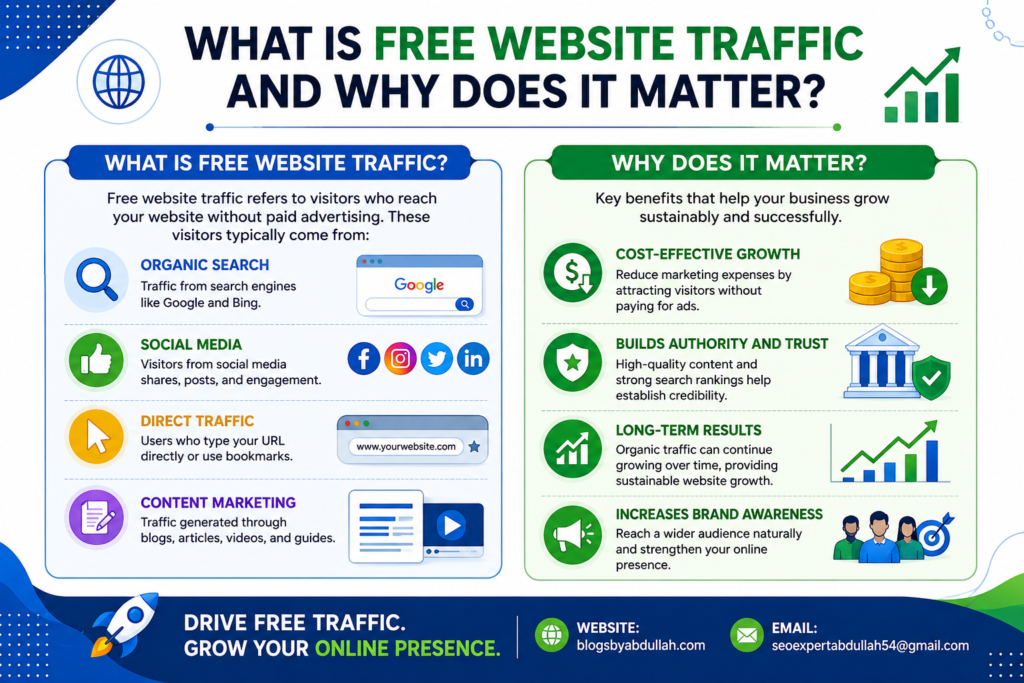
Free website traffic means visitors who come to your site without you paying for ads to bring them there. These visitors find you through search engines, social media, online communities, or links from other websites.
This type of traffic matters because it is sustainable. When you run paid ads, traffic stops the moment you stop spending. But when you rank on Google, build a YouTube audience, or grow an email list, your traffic continues to grow over time without ongoing cost.
Free traffic also tends to convert better because people who find you through search or recommendations are already looking for what you offer.
A blog is one of the most powerful free traffic tools available to any website owner. When you write articles that answer questions your audience is already searching for, Google can rank those articles and send you visitors every single day. The key is to write about topics your audience actually searches for. Use free tools like Google Search Console, Ubersuggest, or even the Google search bar to find keywords people type in regularly. Focus on long-tail keywords which are phrases with three or more words. These are easier to rank for and attract more specific visitors who are closer to taking action. Once you publish a blog post, do not just leave it. Update it every few months with new information. Google rewards fresh and accurate content. Sites that keep their content updated tend to rank higher and hold their positions longer.

Write one article per week consistently. Use your target keyword naturally in the title, first paragraph, and a few subheadings. Add internal links to other pages on your website. Keep your writing simple and easy to read.
YouTube is the second largest search engine in the world and it is completely free to use. Millions of people search YouTube every day looking for tutorials, reviews, how-to guides, and product comparisons.If you create videos that solve problems your audience has, YouTube can send a steady stream of visitors to your website. Include a clear call to action in every video asking viewers to visit your site for more information, a free resource, or a special offer. You do not need expensive equipment to start. A smartphone and good natural lighting are enough in the beginning. What matters most is the value you provide in the video.
Put your website link in the first line of every video description. Create video titles that match what people search for. Add end screens with a link to your website. Upload consistently, even if it is just one video per week.
Your email list is one of the most valuable free traffic assets you can build. Once someone subscribes, you can bring them back to your website anytime you publish something new without spending a single rupee on ads. Offer something valuable in exchange for email addresses. This could be a free checklist, guide, discount code, or mini course. Once someone subscribes, send them useful emails regularly that link back to your website content. Email traffic is unique because these are people who already trust you. They signed up because they liked what you had to offer. That means they are much more likely to click through and take action when you send them a new post or a new product.
Add a signup form to your homepage, blog posts, and footer. Offer a freebie that your audience actually wants. Send emails at least once a week to stay in their minds. Write subject lines that make people want to open the email.
Social media is free to use and gives you access to millions of people every day. The key is to share content that is actually useful and not just promotional. Choose one or two platforms where your audience spends most of their time. If you are a business-to-consumer brand, Instagram and Facebook tend to work well. If you are targeting professionals or businesses, LinkedIn is more effective. Every time you publish a blog post, video, or new product, share it on your social media pages. Include a short description of what it is and why someone should visit your website to learn more. Always add a clear call to action so people know what step to take next.Pinterest is often overlooked but it is actually a search engine. Many websites in fashion, food, home decor, travel, and lifestyle get thousands of visitors per month purely from Pinterest by creating simple image pins that link back to their website.
Post consistently, not just when you feel like it. Use relevant hashtags to expand your reach. Engage with comments and messages to build community. Share other people’s content too, not just your own.
Quora and Reddit are platforms where people go to ask questions and find answers. If you answer questions in your area of expertise, you can position yourself as an authority and drive visitors to your website in the process. On Quora, search for questions related to your niche and write detailed helpful answers. At the end of your answer, you can include a link to a related article on your website if it adds genuine value.On Reddit, join communities called subreddits that are relevant to your industry. Participate genuinely, help people, and occasionally share your content when it is directly relevant to a question being asked. Avoid being too promotional or your posts will be removed.
Focus on providing real value first, promotion second. Build a reputation by answering many questions over time. Link only when your content genuinely adds more detail. Be consistent, even a few answers per week adds up over months.
If you have a local business or even an online service, setting up a free Google Business Profile can bring visitors to your website from Google Search and Google Maps. This is one of the most underused free traffic sources available. When someone searches for a service near them, Google often shows a map with local business listings. If you are on that map with a complete profile, you get traffic without any ads. Make sure your profile has your website link, correct business hours, a clear description, and real photos. Ask satisfied customers to leave reviews because profiles with more positive reviews appear higher in local search results.
Even the best content will not get traffic if Google cannot properly read and index your website. Technical SEO refers to the behind-the-scenes settings that help search engines understand your website. Start by making sure your website loads fast. Nearly half of all users will leave a page if it takes more than two seconds to load. Use free tools like Google PageSpeed Insights to check your loading speed and fix any issues it identifies.Make sure your website works well on mobile phones because more than half of all internet traffic now comes from mobile devices. Also check that you have no broken links, that your pages have proper title tags and descriptions, and that Google can crawl all your important pages.
Submit your sitemap to Google Search Console. Fix all broken links on your website. Make sure every page has a unique title and meta description. Compress your images so they do not slow down your pages.
A backlink is when another website links to yours. Google treats these as votes of confidence and websites with more quality backlinks tend to rank higher in search results. You do not need to beg for links. Instead, create content that people naturally want to share and link to. This includes detailed guides, original research, helpful infographics, free tools, or comprehensive lists.Another way to get backlinks is through guest blogging. Write a helpful article for another website in your industry and include a link back to your own site. This is still one of the most effective ways to build authority and get referral traffic at the same time.
Write original research or surveys that others will cite. Create free resources like templates or tools. Reach out to bloggers and offer to write a guest post. Ask websites that mention your brand to also link to you.
When people search on Google, they often see a box called People Also Ask which shows related questions. If your content directly answers these questions, Google may feature your page in that box and send you extra traffic without any additional effort. Voice search is also growing rapidly. People now ask questions out loud to their phones and smart speakers. Voice search queries tend to be longer and more conversational. Write some of your content in a question and answer format to match how people actually speak and search.
Find common questions in your niche using Google’s People Also Ask section. Write a short direct answer to the question at the top of your article. Follow the short answer with a more detailed explanation. Use simple language that is easy for search engines to extract.
None of the above methods matter if you do not track your results. Without data, you are guessing. With data, you can focus your energy on what is actually bringing you visitors. Use Google Analytics to see where your traffic comes from, which pages get the most visits, and how long people stay on your site. Use Google Search Console to see which keywords your site ranks for and which pages get the most clicks from search. Once you know which traffic sources are working best for you, put more effort into those. If YouTube is sending you more traffic than Instagram, make more videos. If a certain type of blog post gets more visits, write more of those.
Google Analytics measures overall site performance and behavior. Google Search Console shows your search rankings and click data. Ubersuggest provides keyword tracking and competitor analysis. Hotjar shows how visitors interact with your pages through heatmaps.
This is the question most beginners have and most articles avoid answering honestly. Social media and Quora can start sending small amounts of traffic within days of posting. Email traffic depends on how fast you grow your list but even a few hundred subscribers can bring meaningful visits. SEO and blog traffic typically take three to six months before you see real results. This is because Google needs time to discover your content, index it, and test how users respond to it. But once you rank, the traffic is consistent and grows over time. YouTube can start sending traffic within a few weeks if your videos target specific search queries, but building a channel audience takes months of consistent effort.The best approach is to combine multiple sources so you get some traffic quickly while building long-term assets at the same time.

Most beginners make the same mistakes when trying to get free traffic. Knowing these in advance will save you months of wasted effort.The biggest mistake is being inconsistent. Posting twice this week and then nothing for a month sends a signal to both Google and your audience that you are not reliable. Consistency always wins over intensity. Another common mistake is chasing every platform at once. Pick two or three traffic sources and master them before adding more. Doing ten things poorly is worse than doing two things extremely well. Writing content that nobody is searching for is another major issue. Before writing any article, always check that people are actually searching for that topic. Great content that nobody is looking for will never get traffic. Finally, many people quit too early. Free traffic takes time. If you follow a consistent strategy for six months, you will see results. Most people give up after six weeks and never find out what could have happened.

In the first three months you can expect small but growing traffic. With consistent blogging and social sharing, most beginners see between 100 and 500 visitors per month by the end of month three. SEO traffic usually kicks in around months four to six. Realistic expectations help you stay consistent during the slow early phase.
No. Start with two or three and focus on doing them well before adding more. Most successful website owners have one or two primary traffic sources that drive the majority of their visitors. A blog combined with an email list or a YouTube channel combined with Pinterest can be enough to build significant traffic over time.
Both have their place. Paid traffic works instantly but stops when you stop paying. Free traffic takes longer to build but it compounds over time. For anyone with a limited budget, free traffic is the smarter long-term investment. Many successful websites combine both strategies once their free traffic base is established.
Start a blog and publish consistent high-quality articles that target keywords your audience is searching for. SEO-driven blog traffic is the most sustainable and scalable free traffic source for most websites. Combined with an email list to bring readers back, this combination alone can grow your website significantly over twelve months.
Test two or three sources for ninety days each while tracking results in Google Analytics. The source that sends the most visitors and the most engaged visitors is the one worth investing more time in. Different businesses perform better on different platforms depending on their audience and content type.
Yes. You can start with social media, email, and Quora without any technical knowledge. However, learning the basics of SEO even just on-page optimization like using keywords in your titles and writing clear meta descriptions will significantly improve your results over time. Free resources from Google itself are a good starting point.
Free traffic is not a myth. It is a result of consistent effort, the right strategy, and patience. The ten methods covered in this guide are all proven and accessible to anyone regardless of budget or experience level. Start with what feels most natural to you. If you enjoy writing, begin with blogging. If you are comfortable on camera, start with YouTube. If you have an existing audience anywhere, use email to bring them to your website. The most important step is to start today and commit to staying consistent for at least six months. Free traffic rewards persistence more than talent. Anyone who shows up consistently and provides real value to their audience will eventually see their traffic grow.