
Digital marketing is the practice of promoting products, services, or brands through online channels. Instead of a newspaper ad or a billboard, digital marketing uses websites, search engines, social media, email, and paid online advertisements to reach people.
In simple terms: if a business is trying to reach customers through the internet, that is digital marketing in action. It covers everything from the Google result you click on, to the Instagram ad you scroll past, to the email newsletter sitting in your inbox right now.Digital marketing helps businesses grow by connecting them with the right audience online.It combines creativity, strategy, and technology to increase brand awareness and drive sales.
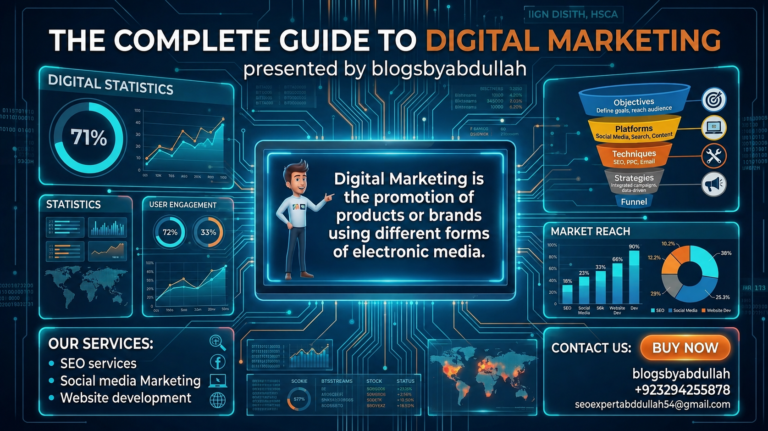
Digital marketing is important because it helps businesses reach a larger audience and connect with potential customers online. In today’s digital world, most people use the internet to search for products, services, and information before making a purchase. Through digital marketing, businesses can promote their brand on search engines, social media platforms, websites, and email campaigns to increase visibility and attract more customers.
Another major advantage of digital marketing is its cost-effectiveness compared to traditional advertising methods. Businesses can target specific audiences based on their interests, location, and behavior, which improves the chances of getting better results. It also allows companies to track performance, measure customer engagement, and make improvements in real time. With the right digital marketing strategy, businesses can build trust, increase sales, and grow their online presence successfully.
Digital marketing works by using online platforms and strategies to connect businesses with people who are interested in their products or services. It helps brands reach potential customers through channels like search engines, social media, websites, email marketing, and online advertisements. Businesses create valuable content, optimize their websites for search engines, run targeted ads, and engage with audiences to increase visibility and drive sales. By analyzing data such as website traffic, clicks, and customer behavior, companies can improve their marketing strategies and achieve better results over time. Digital marketing allows businesses to reach the right audience quickly, build trust, and grow their online presence effectively.
Digital marketing is not one single thing — it is an ecosystem of different channels, each with its own strategy, tools, and strengths.
SEO is the process of making your website appear higher in Google search results without paying for ads. It involves writing useful content, building a fast website, and earning links from other credible sites. SEO is a long-term game — results can take 3–6 months to show, but the traffic it generates is free and consistent over time, making it one of the highest-ROI digital marketing channels available.
Content marketing means creating valuable, useful content — blog posts, videos, podcasts, guides, infographics — to attract and educate your audience. The goal is not to sell directly, but to build trust. A person who reads your blog post today might become a customer six months from now. Content marketing and SEO go hand in hand: great content gives search engines something to rank, and high rankings bring new readers to your content.
Social media marketing involves using platforms like Instagram, Facebook, LinkedIn, TikTok, and X (Twitter) to reach and engage your audience. Brands can post organically (for free) or run paid ads to reach a targeted audience based on age, interests, location, and behavior. Short-form video — Reels, TikToks, YouTube Shorts — has become the dominant content format in 2025–2026, offering massive organic reach for brands willing to show up consistently.
Email marketing is direct communication with your audience — subscribers who have voluntarily given you their email address. It remains the highest-converting digital channel because the audience is already warm and interested. Effective email marketing involves a mix of value-driven content and commercial messages. The brands that do email well nurture their list consistently, not just when they want to sell something.
PPC advertising lets you pay to show your ads in front of specific audiences. Google Ads appear at the top of search results. Meta Ads appear in Facebook and Instagram feeds. TikTok Ads appear between videos. You only pay when someone clicks your ad. PPC delivers instant visibility, unlike SEO which takes months. The downside is cost — if your campaigns are not well-optimized, you can spend a lot of money without seeing returns.
Affiliate marketing is a performance-based model where you earn a commission for every sale you generate for another company. You share a unique tracking link — in a blog post, YouTube video, or social media post — and when someone buys through it, you get paid.
Influencer and Creator Marketing
Brands partner with creators — people with engaged audiences on YouTube, Instagram, or TikTok — to promote their products authentically. Micro-influencers (10K–100K followers) often deliver better engagement and ROI than mega-celebrities.
Here is the practical flow every successful digital marketing strategy follows:
Offer services like SEO audits, social media management, email campaign setup, or content writing to businesses on platforms like Upwork, Fiverr, or LinkedIn. This is the fastest path to your first dollar — many beginners land their first paid project within 2–4 weeks.
Build a content site around a specific topic, grow organic traffic through SEO, and monetize with display ads, affiliate links, and digital products. This takes 12–24 months to become meaningful income, but it scales beautifully over time.
Build an audience — through a blog, YouTube channel, email list, or social media — and earn commissions by recommending products you genuinely use and believe in. The key in 2026 is trust: audiences ignore spammy affiliate content but respond well to honest, personal recommendations.
Package your digital marketing knowledge into a course, ebook, or template and sell it through platforms like Teachable, Gumroad, or your own website. This creates passive income — you do the work once and sell it repeatedly.
Businesses spend billions on Google Ads and Meta Ads every year and many desperately need someone who actually knows what they are doing. If you develop PPC skills, you can charge premium rates as a specialist ad manager or consultant.
Once you have built skills and client experience as a freelancer, you can hire other specialists and scale into an agency. Agencies serving small-to-medium businesses typically charge $2,500–$12,000 per month per client

You do not need a degree, a large budget, or years of experience to begin. Here is a simple three-step path:
Most people who consistently apply these three steps for 90 days have enough skills and portfolio work to start landing their first clients or applying for entry-level roles.
Yes. Methods like content writing, social media management, and basic SEO consulting require no formal experience — just the willingness to learn. Beginners typically earn their first $100–$500 within 30–60 days of consistent effort on freelancing platforms like Upwork or Fiverr.
Income varies enormously by method and experience level. Beginner freelancers earn $500–$2,000 per month. Experienced specialists or agency owners commonly earn $5,000–$30,000 per month. Passive income streams like blogs and affiliate sites can scale to six figures but take 1–3 years to build.
No. Most digital marketing income paths are skills-based, not credential-based. Google, HubSpot, Meta, and Semrush all offer free certifications that carry real weight with clients and employers. A strong portfolio beats a degree almost every time.
The standard delivery time ranges from 7–14 business days, depending on project size and complexity.
Paid ads management (especially Google and Meta), technical SEO, marketing automation, and conversion rate optimization (CRO) consistently command the highest rates — often $75–$200+ per hour for experienced specialists.
Start by doing free or discounted work for a local business, nonprofit, or a friend's brand to build portfolio pieces. Use those results as case studies to attract paying clients. Alternatively, offer a small, low-risk service like a free SEO audit as a foot-in-the-door offer.
Yes. Affiliate marketing, blogging, online courses, and subscription content can all generate ongoing income with minimal ongoing effort — but only after an active build phase of 6–24 months. There is no truly instant passive income; it is deferred active income.
AI tools like Claude, ChatGPT, and Jasper allow marketers to produce content, conduct research, and build campaigns significantly faster. However, strategy, relationship-building, and creative judgment remain distinctly human advantages that AI cannot replace.
Absolutely not. The global digital advertising market continues to grow, and businesses of every size need skilled digital marketers. Niching down and building genuine expertise always creates opportunity — regardless of when you start.
Most people can reach beginner-level earning capability in 1–3 months of focused learning. Reaching a full-time income typically takes 6–18 months. Building a truly scalable passive income business is usually a 2–3 year journey.
Digital marketing is one of the most accessible, high-demand, and financially rewarding skill sets available today. Every business needs it, most businesses do not do it well, and there has never been more free learning content available to help you get started.
The only thing that separates the people who succeed from the people who stay stuck is consistent, focused action. Pick a direction, start learning, and keep going.